


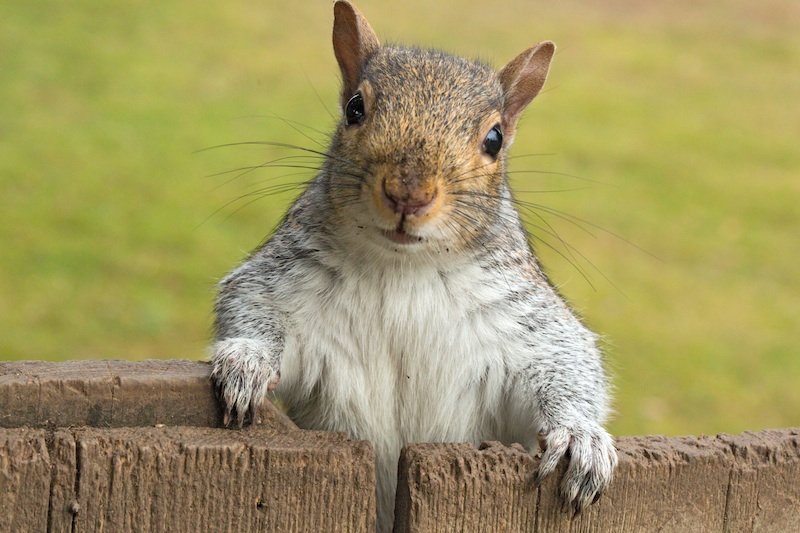
This post continues a discussion outlined in Part I concerning whether a man that walks around a tree goes around the squirrel on the opposite side of the tree and that moves so as to prevent the man from seeing him.
A better solution?
Let’s consider the path the man traced out as he circled the tree: does the path go around the squirrel?
Clearly it surrounds the squirrel. So, should we say that neither of the proposed definitions is correct but instead “to go around” means to trace a path that surrounds? Sounds right to me.
Comment
In order for there to be an issue for discussion, we must have some common understanding of what the issue is, and so have a general understanding of what our terms mean. In the example of the squirrel, it becomes clear that there are two points of view of the same reality and that those points of view are not in disagreement with each other. The disagreement is only apparent because the same words are being used: one side says, “The man went around the squirrel,” while the other says, “The man did not go around the squirrel.” What is evident is that they are not addressing the same issue because they mean different things by “going around”. We can join William James and leave it at that and say simply that the truth in the case depends on our preferred definition.
I don’t think it is so simple. While we can choose to assign any definition we want to any word, the point of common definitions is to help us communicate. In order to communicate we must agree on the meaning of the words we use. In a real sense, the squirrel issue becomes a problem because the participants failed to communicate—they were not in basic agreement on the meaning of their terms.
Here is the central question: “Is it simply a matter of personal taste what meaning we assign to the terms we use?” In the largest sense it is, since our language is essentially a matter of convention. For some people the sound “we” means the group to which the speaker belongs, and for others it means affirmation (“Oui” in French). But once we have a basic vocabulary down, we are bound by the existing meanings if we wish to maintain communication.
Furthermore our ability to communicate assumes that we share a common understanding of the world to which we make reference. In the case of the squirrel, the assumption is that we all understand what physically happened (the man walked around the clearing, the squirrel continually faced the man, etc.) and that we have a common understanding of the question. To address the reality before us, some definitions will be more suitable than others. If we agree that “going around” means to create a path that contains or surrounds and that this is a better definition then either definition used in the debate, then we can decide the issue: the man does go around the squirrel.
A further comment
Some philosophers maintain that all philosophical issues can be decided simply by clarifying our definitions, They say, for example, that the reason we vex ourselves with whether or not God exists is that we are not clear what we mean by “God.” If we clarify that term we will have resolved our question. (Nearly 1,000 years ago Anselm’s so-called ontological argument claimed to show this is so. Even to this day some think it still works.)
Some go even further and say that all philosophical (or at least metaphysical) questions arise only because we are confused in our terminology. Clarifying our meaning will cause the problems to disappear. The difficulty with this view is that it concentrates exclusively on the level of language and ignores the more important substantive level. In the case of the squirrel debate, re-examining what happened leads us to the correct definition (circumscribing a path) on the basis of which we can answer the question. The problem remains as a question and is solved, not eliminated, by proper attention to our terms.
But wait!
It may be objected that the path isn’t “real”. Let’s save that for later and have a look at bricks for what could be more real than bricks?

