


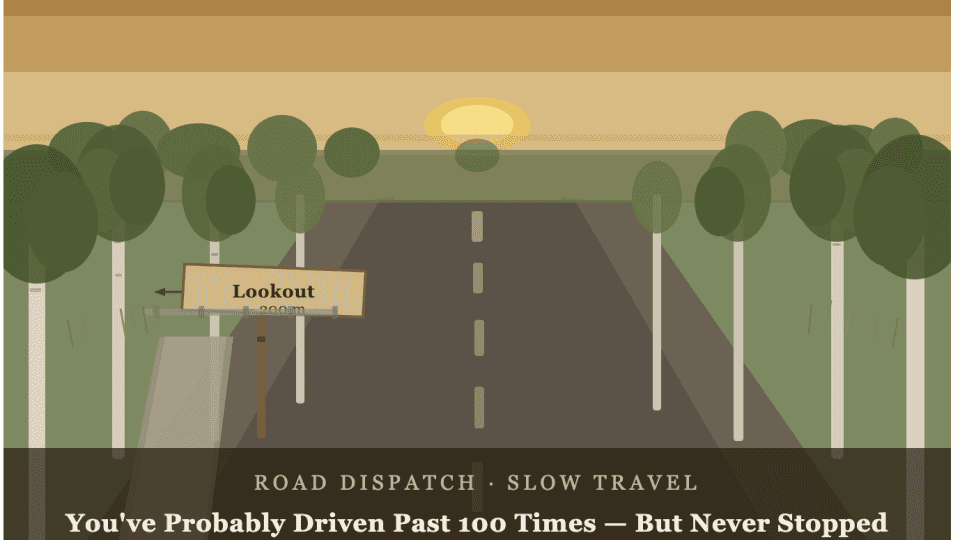
This is not a travel piece about a hidden gem that isn’t hidden. It isn’t a listicle with a headline promising secret spots now ruined by the algorithm. This is something quieter: a small argument for pulling over, for killing the engine, for letting the radio die and listening to whatever is actually happening on the other side of the guardrail.
Because what’s down that lane — or the one near you, whichever one you keep meaning to explore — is almost always worth the four minutes it costs you.
The Particular Pleasure of the Unknown Stop
There is something disorienting, in the best way, about stopping somewhere with no reviews. No star rating. No photo tagged at this location. No one has written the words “hidden gem” in an italicized caption and gazed meaningfully at the middle distance here. The place exists in complete indifference to whether you arrive or not.
That indifference is the thing. Somewhere between the first roadside diner and the ten-thousandth Instagram reel promising a “must-visit,” we started treating travel as a form of confirmation. We go to prove the thing is as good as advertised. We photograph the thing to prove we were there. The roadside stop that nobody knows about breaks that loop entirely.
The lane behind the crooked sign opens onto an old orchard — rows of apple trees gone leggy and wild, the grass tall between them, a rusted hand-pump near what might once have been a farmhouse foundation. There is nobody here. There is no explanation. You are left to wonder, and wondering turns out to be its own kind of reward.
What You Actually Find
Sometimes it’s a creek. Sometimes it’s a cemetery with stones dating back to the 1820s, names worn smooth, small carved lambs for the children. Sometimes it’s a woman named Doris selling jars of wild blueberry jam from a folding table under a beach umbrella, no card reader, exact change appreciated, and she will tell you about the weather this summer if you give her a moment, which you should.
Once, on a drive through the St. John River Valley, stopping at a sign that said only “Lookout — 200m,” I found a bench facing west over a bend in the river, the water turned copper in the late afternoon, a single great blue heron standing in the shallows with the absolute patience of a creature that has never once been in a hurry. I sat on that bench for thirty minutes. I had nowhere to be that couldn’t wait thirty minutes. Almost nothing can’t wait thirty minutes.
The thing about the bench, the heron, the jar of blueberry jam — none of it would have been remarkable anywhere else. It was remarkable because I had not expected it. Expectation is the enemy of wonder, and the roadside stop with the crooked sign asks nothing of you in advance.
The Art of the Unhurried Detour
The practical objection is always time. The drive is already four hours. There are people waiting. The dog needs out. The children are asking if we’re there yet and the honest answer, if you pull over, becomes: not quite, but look at this.
Look at this is a complete sentence. It is one of the better things you can say to a child — or to yourself — in a car that has been moving for too long. The detour doesn’t need to justify itself with a waterfall or a historic plaque. It justifies itself by existing outside the plan.
Some of the best advice I’ve ever received about driving anywhere was this: leave twenty minutes earlier than you think you need to, and spend those twenty minutes badly. Stop for no reason. Take the road you don’t recognize. Pull over at the sign. Let the trip be a little longer than the destination requires. You are, after all, not a package being shipped. You are a person going somewhere, and the going is part of it.
How to Find Your Crooked Sign
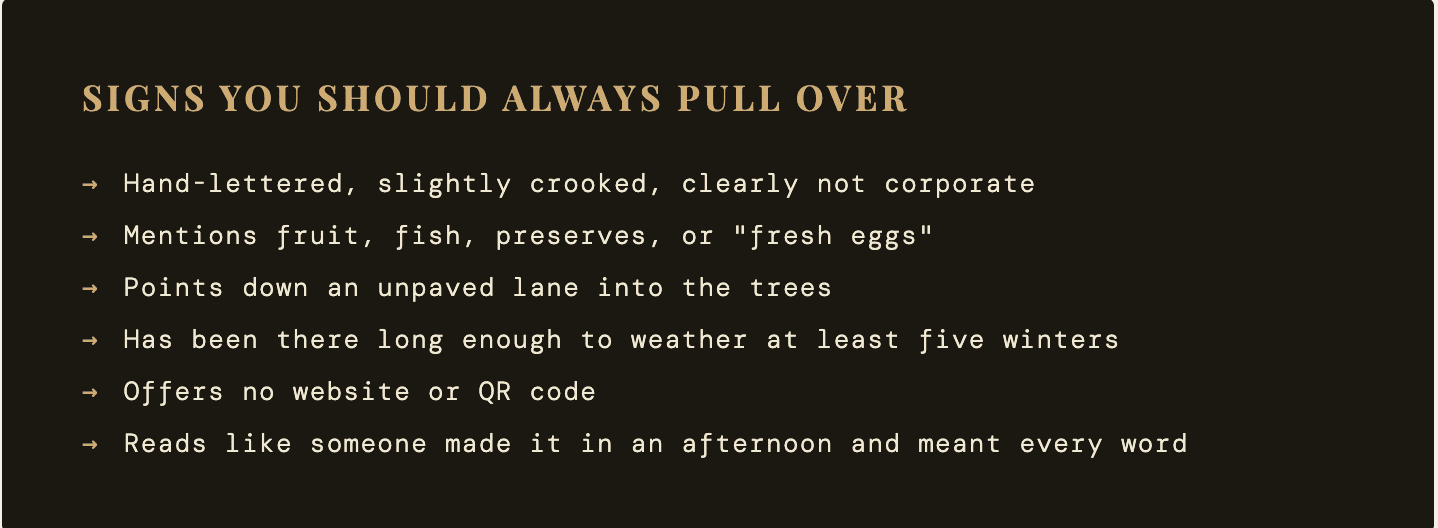
You don’t find it by searching. That’s the whole point. You find it by driving the route you’ve always driven and, this time, actually looking at the side of the road. The signs are there. They have always been there. They are small and sun-faded and they do not advertise on social media, which is precisely what makes them worth finding.
The gravel lane. The handwritten letters. The arrow pointing somewhere you’ve never been. The reasonable certainty that the detour will cost you almost nothing and might, with a little luck, give you something you didn’t know you were looking for.
Pull over. Kill the engine. See what’s there.
It has been waiting.

