


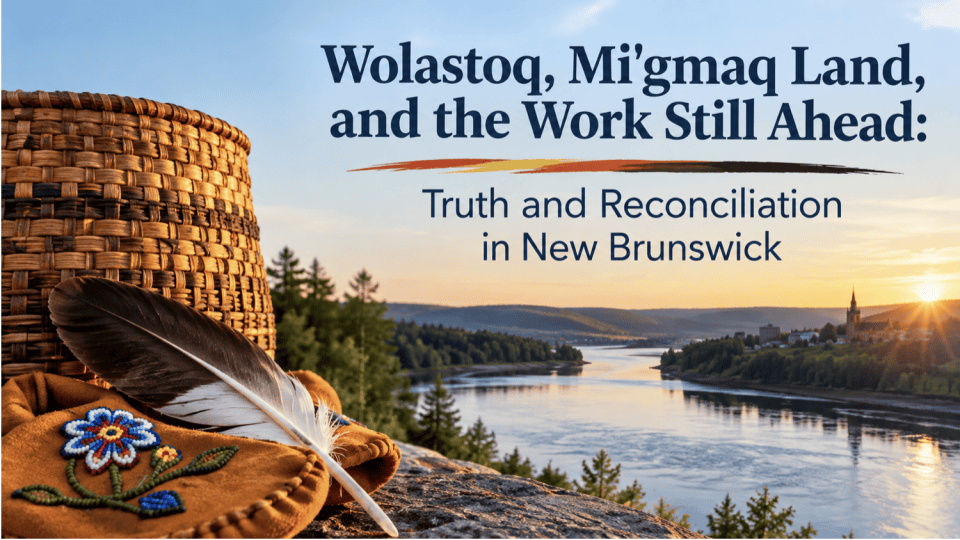
Today, September 30, Canadians mark the National Day for Truth and Reconciliation. It is a day to remember the children who never came home from residential schools, to honour the survivors and their families, and to reflect on what each of us can do to move reconciliation beyond words.
The day is also known as Orange Shirt Day, which grew out of the story of Phyllis Webstad. At six years old, she had her new orange shirt taken from her on her first day at a residential school. Her story became a symbol of the identity, dignity and belonging that the residential school system tried to strip away. Canada made September 30 a federal statutory holiday in 2021, following the Truth and Reconciliation Commission’s 2015 report and its 94 Calls to Action.
Why it matters here
New Brunswick is the homeland of three Indigenous nations: the Wolastoqiyik (Maliseet), the Mi’gmaq (Mi’kmaq) and the Peskotomuhkati (Passamaquoddy). The Wolastoq, the river many of us call the Saint John, takes its name from the Wolastoqiyik, the “people of the beautiful river.” For thousands of years these nations have lived, governed, fished, travelled and told their stories across this land.
Much of New Brunswick is also covered by the Peace and Friendship Treaties signed in the 1700s. These agreements were never about giving up land. They were about sharing it and living alongside one another respectfully, which is a useful reminder that the idea of reconciliation has deep roots here.
Many First Nations children from New Brunswick were taken from their families and sent to residential schools outside the province, including the Shubenacadie school in Nova Scotia and the school at Restigouche in Quebec. The harm of those schools, including lost languages, broken family bonds and intergenerational trauma, is part of New Brunswick’s history and continues to shape the lives of people in our communities today.
Truth comes before reconciliation
Reconciliation starts with learning the truth, including the uncomfortable parts. That means reading survivors’ accounts, learning whose territory you live on, and understanding treaty rights and why they matter. It also means recognizing that disputes such as the 1999 Mi’gmaq fishing conflict in Esgenoôpetitj, which followed the Supreme Court’s Marshall decision, grew out of long-standing questions about treaty rights that remain part of the conversation in our province.
What you can do
- Wear orange today, and keep learning after the day is over.
- Learn the language. Wolastoqey and Mi’gmaq are living languages, and revitalization efforts in the province deserve support.
- Support Indigenous-led organizations, artists, authors and businesses in New Brunswick.
- Read the Calls to Action and ask how your workplace, school or community can respond to them.
- Attend a local event. Many communities, schools, universities and First Nations hold ceremonies, walks, talks and gatherings today.
Reconciliation is not a single day on the calendar. It is a long-term relationship built on honesty, respect and action. September 30 invites all of us in New Brunswick to listen, to learn and to keep walking together, every day of the year.
Every child matters.

