


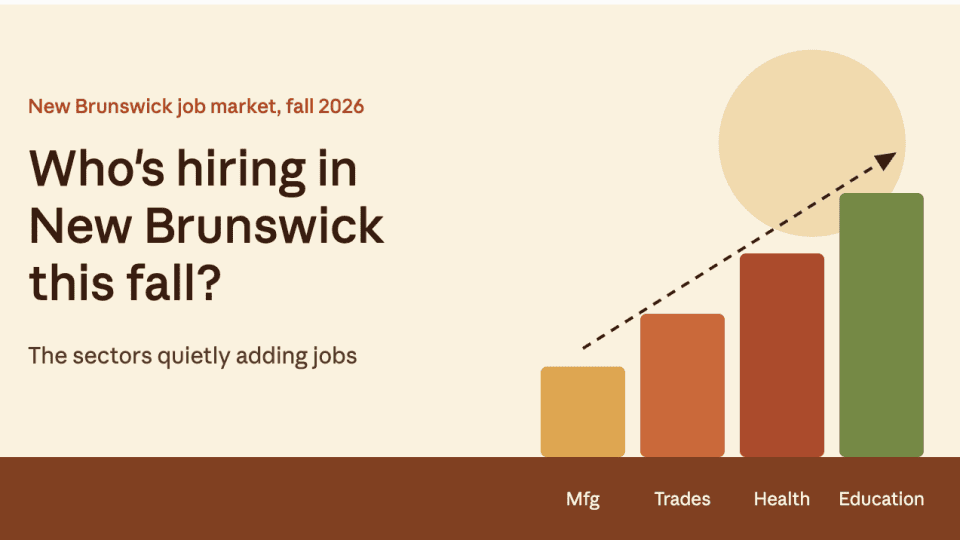
New Brunswick’s job market doesn’t make headlines the way Alberta’s or Ontario’s does, but the numbers show a steady, uneven recovery. Employment rose by 2,400 (+0.6%) in New Brunswick in August, while most other provinces were little changed. That’s a small gain, but the province is moving in the right direction.
It’s not all good news, though. The province’s unemployment rate was 7.3% in August, up 0.3 points from July. More people are looking for work, and the jobs aren’t spread evenly across sectors or regions.
Here’s where the hiring appears to be.
Manufacturing: the quiet workhorse
Manufacturing was the standout last year. It added 5,700 jobs in 2025, the biggest gain of any industry in the province. That fits the broader picture, where goods-producing industries accounted for just over half of the province’s employment growth, adding 2,900 jobs (+3.6%).
New Brunswick’s manufacturing base is a mix of food processing, forest products and advanced manufacturing. Nationally, manufacturing job vacancies in June were up 17.3% from a year earlier, according to Statistics Canada data cited by one industry roundup. That’s a Canada-wide figure, not a provincial one, but it suggests employers are still trying to fill roles. If you have technician, machine operator or plant-floor experience, this is a good place to look.
Construction and the skilled trades
Job boards are full of postings in Moncton, Dieppe and Bathurst, ranging from labourers and apprentices to estimators and project managers.
The province’s own priorities point the same way. The 2026 Priority Occupations List covers 33 occupation codes across healthcare, education and construction trades. Governments don’t target occupations like these unless there are real gaps to fill.
Health care and education
These two sectors aren’t glamorous, but they’re consistent. Since May 4, new invitations under the NB Experience pathway have been limited to healthcare, education and construction trades. That’s a strong signal about where the province sees its biggest shortages. Nurses, allied health professionals, teachers and early childhood educators are still in demand.
Transportation, IT and professional services
These are smaller pools, but they haven’t gone cold. New Brunswick’s other immigration streams invited candidates in manufacturing, transportation, professional and IT, and sales and services occupations in July 2026. Selection priorities change, so treat this as a snapshot of demand rather than a guarantee.
It depends on where you live
Regional differences matter as much as sector. Over the past year (as of the August snapshot):
- Edmundston–Woodstock added 3,400 jobs (+9.3%), with full-time work making up most of the gain.
- Saint John–St. Stephen added 3,000 jobs (+3.2%), and the growth was entirely full-time.
- Campbellton–Miramichi lost 6,700 jobs (-9.3%), with both full-time and part-time work falling.
A strong provincial number can hide a very different reality in your own region.
What to do with this
- Look at the trades and manufacturing first. Both have steady postings and clear entry points, including apprenticeships.
- Use the sector, not just the job title. Many manufacturing, health and construction roles are open to people from related fields with some retraining.
- Check regional numbers before relocating. The Edmundston–Woodstock and Saint John–St. Stephen gains are real, but so is the drop in the northeast.
- Watch the next data release. Statistics Canada’s September Labour Force Survey comes out on October 9 and will show whether August’s gain held.
A caveat
Provincial data is lumpy, and monthly changes can be revised. The employer-level hiring picture (who is actually posting) is best checked directly on job boards and the province’s Job Bank pages. This post is a guide to where to look, not a promise of openings.

