

If you’ve tried to find a family doctor in New Brunswick recently, you already know the feeling: a long hold on an 811 line, a referral to NB Health Link, and the quiet resignation that a permanent primary care provider might be years away — if it comes at all.
The government holds press conferences. The numbers tick up slightly. Officials declare cautious optimism. And yet, for a significant portion of New Brunswickers, the door to consistent, ongoing care remains firmly closed.
So what is actually going on? The answer is more complicated — and more troubling — than the headlines suggest.
The Numbers Are Real, But They Don’t Tell the Whole Story
In late April 2026, Premier Susan Holt stood at a podium in Fredericton to announce progress on her government’s five-year health plan. The headline figure was encouraging: the province recorded its highest-ever net increase of physicians in the last fiscal year, adding 67 new doctors, including 15 family physicians. Nurse turnover at Horizon Health Network dropped sharply, from over five per cent to below one per cent, aided by $10,000 retention bonuses introduced in 2025.
But here’s the catch: a net gain in physicians doesn’t mean the shortage is shrinking. It means it’s growing more slowly.
As of early 2025, there were still 167.4 physician vacancies in the province — the exact same number as the year before, despite a net gain of 89 doctors over the previous three years. How is that possible? Because the number of physician positions keeps expanding as new programs and clinics are launched. The system is growing its demand faster than it can fill the supply.
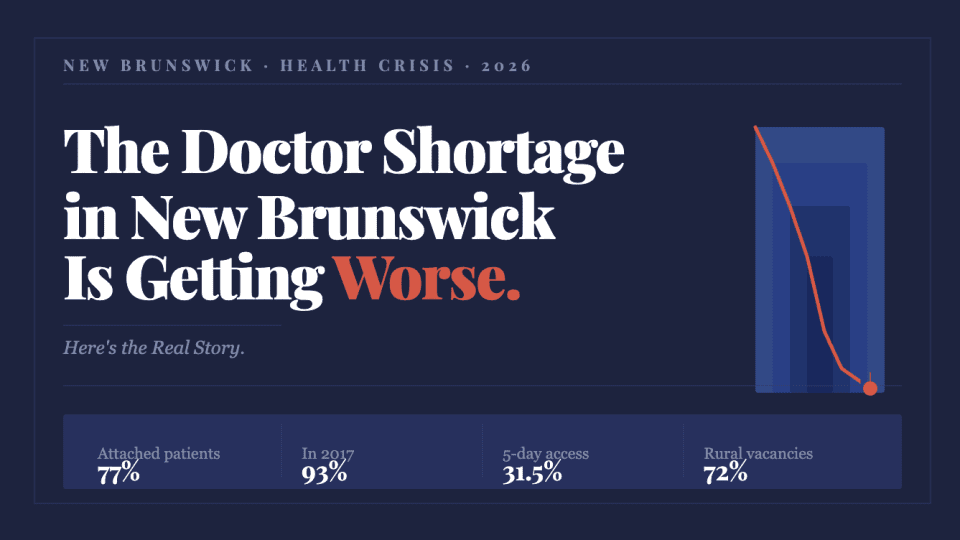
Meanwhile, the 2024 Primary Care Survey found that only 77 per cent of New Brunswickers reported having a permanent primary care provider — down two per cent from 2023, and a steep drop from 93 per cent just eight years ago in 2017. The Health Council’s CEO, Stéphane Robichaud, has noted that if not for provincial initiatives like collaborative care clinics, that number would have fallen even further. That’s a sign of damage control, not recovery.
The Measurement Problem
Perhaps the most quietly alarming part of this crisis is how hard it is to count.
In February 2025, Eric Beaulieu, the province’s deputy minister of health, briefed MLAs on the public accounts committee — and what he revealed was a measurement maze. The 104,000 people registered with NB Health Link, the province’s bridge service for those without a provider, do not actually represent the full number of New Brunswickers without a family doctor or nurse practitioner. Many unattached patients simply haven’t registered. Others have given up entirely.
“The questions seem very straightforward, but they are not,” Beaulieu told the committee.
One federal-provincial agreement set a target of getting 55.8 per cent of the population access to their care provider within five days by March 2026. A recent Health Council report found the actual figure sitting at 31.5 per cent. That’s not a near-miss. That’s a gap that should be generating alarm.
Rural New Brunswick Bears the Brunt
If the province-wide numbers are concerning, the rural picture is far worse.
About 72 per cent of all physician vacancies in New Brunswick exist in rural areas. In francophone rural New Brunswick — served primarily by Vitalité Health Network — that figure climbs to 85 per cent of the network’s vacancies. These are communities where geography already makes access difficult. Where the nearest emergency room might be an hour away. Where continuity of care isn’t a luxury — it’s what determines whether a chronic condition is caught early or discovered in crisis.
Compounding this: roughly 35 per cent of New Brunswick’s family doctors will be eligible for retirement within five years. And the younger physicians replacing them typically carry smaller patient loads than their predecessors — which means fewer patients per doctor, even as the number of doctors slowly rises.
What’s Being Tried — and What’s Still Missing
The Holt government has not been idle. The four-year, $270-million agreement signed with the New Brunswick Medical Society in November 2025 aims to reshape how doctors are paid, introducing incentives tied to patient attachment and same-week access rather than simple fee-for-service billing. Health Minister Dr. John Dornan acknowledged that the province was “15 per cent behind specialists nationally, 20 per cent behind in primary care” before the deal — a striking admission of how uncompetitive NB’s compensation model had become.
There’s also a federal piece: in December 2025, Ottawa announced a new Express Entry immigration category designed to fast-track internationally trained physicians, with work permits processed in roughly 14 days. Starting in early 2026, provinces can use this to nominate practice-ready doctors. Whether New Brunswick can turn those arrivals into long-term commitments — given the province’s history with physician recruitment and retention — remains to be seen.
The province’s goal is to have 81 per cent of New Brunswickers attached to a primary care provider by the end of 2026. Given the current trajectory, that will require not just recruitment, but a systemic rethinking of where and how care is delivered.
The Human Cost of a Statistic
Behind every percentage point is a person navigating a system not designed for them.
Someone managing diabetes without consistent oversight of their bloodwork. A senior whose declining cognition goes untracked because there’s no physician who knows their baseline. A person with a new and frightening diagnosis who calls 811 and waits.
Having adequate preventive care reduces the pressure on emergency rooms dramatically. When that care disappears, the ER becomes the default — the most expensive and least appropriate setting for managing chronic or preventable conditions.
The provincial government deserves credit for transparency — Premier Holt has been notably candid that things aren’t good yet, and has committed to public accountability checkpoints on the five-year plan. But transparency without results is cold comfort to someone waiting two years for a family doctor in Woodstock or Caraquet.
What Needs to Happen
There is no single fix. But the path forward has a shape:
Retention must be the priority, not just recruitment. Attracting a physician to New Brunswick means little if they leave after two or three years. The $10,000 retention bonuses for nurses are a start; the physician compensation reform is more substantial. But working conditions — call schedules, administrative burden, professional isolation in rural areas — matter as much as dollars.
The province should leverage AI and team-based care aggressively. Premier Holt has pointed to artificial intelligence as a way to reduce the administrative load on physicians, freeing more of their time for patients. Nurse practitioners, pharmacists, and allied health professionals need to operate at the top of their scope. Every task that doesn’t require a physician shouldn’t require a physician.
Rural francophone communities need a targeted strategy. An 85 per cent vacancy rate in Vitalité isn’t a general physician shortage — it’s a specific, structural failure in a specific community. Addressing it requires specific solutions: bilingual recruitment pipelines, rural incentive packages, and a commitment to linguistic continuity of care.
Measurement needs to improve. The province cannot manage what it cannot accurately count. A clearer, standardized picture of exactly how many New Brunswickers are unattached — not just those registered on a list — is essential to setting realistic targets and holding the system accountable.
New Brunswick’s doctor shortage did not begin with any single government or any single decision. It has been decades in the making — shaped by underinvestment, demographic change, and a model of care delivery built for a different era.
But the decisions made in the next two to three years will determine whether this is a crisis with an end in sight, or one that becomes permanent. The government is finally being honest about how bad things are. Now it needs to be as ambitious in its solutions as the problem demands.
Sources: CBC News, New Brunswick Health Council, Canadian Press, NB Media Co-op, CARP Canada

