


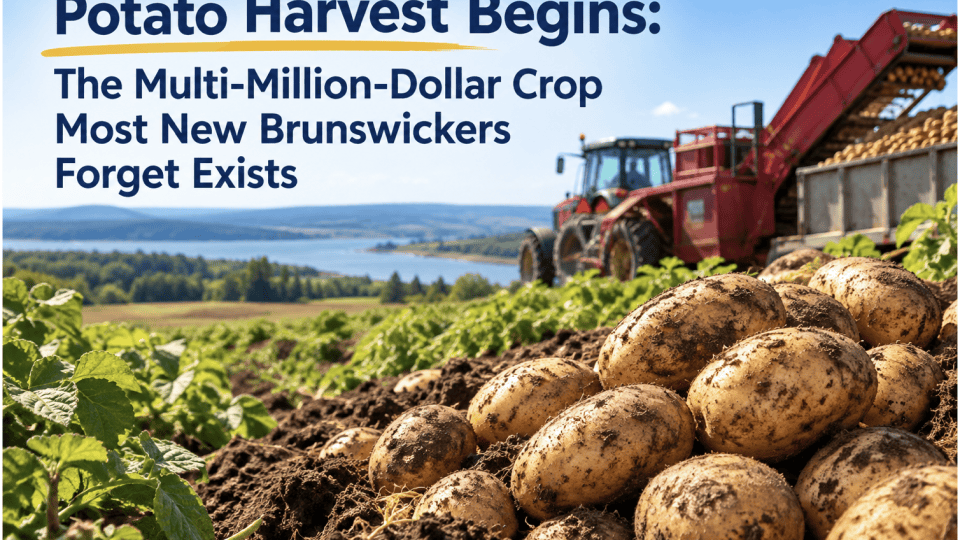
Right now, across Carleton and Victoria counties, harvesters are rumbling through the fields of western New Brunswick, pulling this year’s potato crop out of the ground one row at a time. It happens every September, and yet most people in the province barely notice. Ask someone in Saint John or Moncton what New Brunswick’s biggest agricultural export is, and you’ll probably get a shrug — maybe a guess at lobster or blueberries. Almost no one says “potatoes.” But they should.
A Billion-Dollar Crop Hiding in Plain Sight
New Brunswick’s potato belt, centered around towns like Grand Falls, Florenceville-Bristol, and Woodstock, quietly produces one of the most valuable crops in the province. The industry is often described as worth well over a billion dollars a year once you account for the full chain — growing, packing, processing, and shipping. Add to that the fact that Florenceville-Bristol is the birthplace of McCain Foods, now the largest potato processor on the planet, and you start to see why this stretch of the province has earned an outsized reputation in the global food industry, even if most New Brunswickers drive past the fields without a second thought.
Every fall, roughly 20,000 hectares of land across the province come into harvest. More than half of that crop is destined for processing — think frozen fries and hash browns bound for grocery stores and restaurants worldwide. About a quarter goes to the fresh market, sold as table potatoes, and the rest becomes seed stock, which growers plant again the following spring.
New Brunswick’s Seed Potato Reputation
One part of the industry that rarely gets attention is seed potatoes. New Brunswick is Canada’s largest exporter of seed potatoes, with thousands of acres dedicated specifically to producing disease-free, high-quality seed stock that gets shipped to growers around the world. Fredericton’s Plant Propagation Centre plays a key role here, producing hundreds of thousands of potato plantlets a year through tissue culture labs — a level of agricultural science most people would never associate with a humble potato.
A Tougher Year in the Fields
This year’s harvest arrives against a backdrop of a slightly tighter season across the region. Provincial yields dipped somewhat in 2025 after drought conditions affected parts of eastern Canada, and New Brunswick’s production came in a few percentage points lower than the year before. Seeded acreage across the province has stayed relatively steady heading into 2026, even as growers in some other regions pulled back. It’s a reminder that this industry, for all its scale, is still fundamentally at the mercy of weather, soil, and a growing season that only lasts so long before frost sets in.
Why It’s Easy to Forget
Part of the reason this industry flies under the radar is geography. Most of the population centers — Saint John, Moncton, Fredericton — sit well outside the potato belt. Unless you grew up in or near Carleton County, you likely haven’t seen a potato harvest in person, watched the trucks lined up outside a storage warehouse, or driven past fields being turned over by a harvester in the golden light of a September afternoon.
There’s also the simple fact that potatoes aren’t glamorous. They don’t have the coastal romance of lobster or the tourism appeal of the Bay of Fundy. They’re a working crop, grown by working farms, mostly out of sight of the highways tourists take through the province. But the economic footprint is real: thousands of jobs across growing, packing, trucking, and processing, and a global customer base that stretches far beyond Atlantic Canada.
Worth a Second Look
So as harvest season kicks into gear this month, it’s worth pausing for a moment to consider what’s happening a few hours up the highway. Somewhere around Grand Falls or Florenceville right now, a farmer is watching a monitor in a harvester cab, a truck is being loaded with potatoes destined for a McCain plant, and a warehouse worker is stacking crates of seed potatoes bound for another country entirely. It’s not flashy, but it’s one of the quiet economic engines that keeps a good chunk of rural New Brunswick running — and it deserves a little more recognition than a shrug.

