


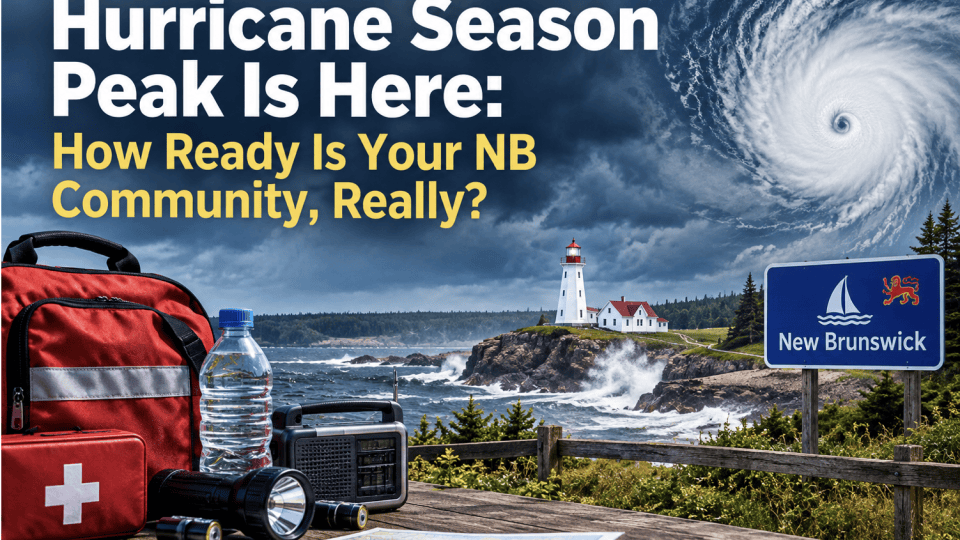
September has arrived, and for anyone living in New Brunswick, that means one thing: we’re now in the most dangerous stretch of the Atlantic hurricane season. While the season technically runs from June 1 to November 30, forecasters and emergency officials consistently point to September as the peak window for the Maritimes — the month when storms are most likely to track far enough north to actually reach us.
It’s easy to think of hurricanes as a “somewhere else” problem — a Florida thing, a Gulf Coast thing. But New Brunswickers don’t have to look far back to be reminded otherwise. Post-tropical storm Fiona tore through Atlantic Canada, leaving behind flattened trees, damaged roofs, and extended power outages across the region. Storms don’t need to make full hurricane landfall to cause serious disruption here; by the time they reach our coastline, they’ve often weakened into post-tropical systems, but they can still bring destructive wind, heavy rain, and storm surge.
So the real question isn’t whether another storm will test the province again. It’s whether your household and your community are actually ready for it — not in a vague, “I’ll figure it out” way, but in a concrete, practical way.
The 72-Hour Rule
New Brunswick’s Emergency Measures Organization (EMO) has one consistent message every hurricane season: be ready to be self-sufficient for at least 72 hours. That’s the rough window emergency services use as a benchmark, since first responders and utility crews may be stretched thin or temporarily unable to reach every affected area right after a major storm.
A solid 72-hour kit isn’t complicated, but it does need to be assembled before the wind picks up, not during. At a minimum, it should include:
- Enough water for each person (about 2 litres per day)
- Non-perishable food that doesn’t need cooking
- A flashlight and extra batteries, or a hand-crank radio
- A basic first aid kit and several days of any essential medications
- Copies of important documents (ID, insurance, medical info)
- Cash, since debit and credit systems can go down with the power
- A plan for pets, since not every shelter accommodates them
If your kit still has last year’s expired granola bars in it, now is the moment to check.
Power Outages Are the Real Story
Wind and rain get the headlines, but for most NB communities, the lasting impact of a storm is the power outage that follows. Downed trees and lines can knock out electricity for days, especially in rural areas where crews have farther to travel and more terrain to clear. If your household relies on electricity for heat, medical equipment, well water pumps, or a sump pump, that’s the vulnerability worth solving now — whether that means a generator, a battery backup, or simply a clear plan for where you’ll go if the power stays out longer than expected.
Know Before You Need To Know
Being “ready” isn’t just about supplies — it’s about information. A few things worth doing before the next storm warning goes out:
- Sign up for local alerts. Many NB municipalities use systems like Voyent Alert to push out emergency notifications directly to your phone. If you haven’t signed up, do it today, not the night before a storm.
- Know your evacuation routes and shelter locations, especially if you’re in a coastal or flood-prone area.
- Check in on neighbours, particularly older adults or anyone living alone. Community resilience during a storm often comes down to who’s checking on whom.
- Secure the outside of your home ahead of time — trim weak branches, tie down or store outdoor furniture, and clear gutters so heavy rain has somewhere to go.
The Community Layer
Individual preparedness matters, but so does the bigger picture. Municipal EMOs across New Brunswick coordinate response and recovery at the local level, working alongside the provincial EMO in Fredericton when a storm’s impact exceeds what a single town can handle on its own. That system works best when residents are informed participants in it — when people know where their nearest shelter is, understand municipal alert levels, and aren’t relying entirely on emergency crews to solve problems that a well-stocked kit and a bit of planning could’ve handled.
So, How Ready Are You?
If your honest answer is “not really,” you’re not alone — and you still have time to change that answer before the next system starts brewing in the Atlantic. Hurricane season doesn’t end until the end of November, and NB’s peak risk window is happening right now. An afternoon spent building a kit, checking your alert settings, and talking to your household about the plan is a small investment against a storm that, sooner or later, will test this region again.
The Maritimes aren’t strangers to storms. The only real variable is how ready we choose to be for the next one.

