


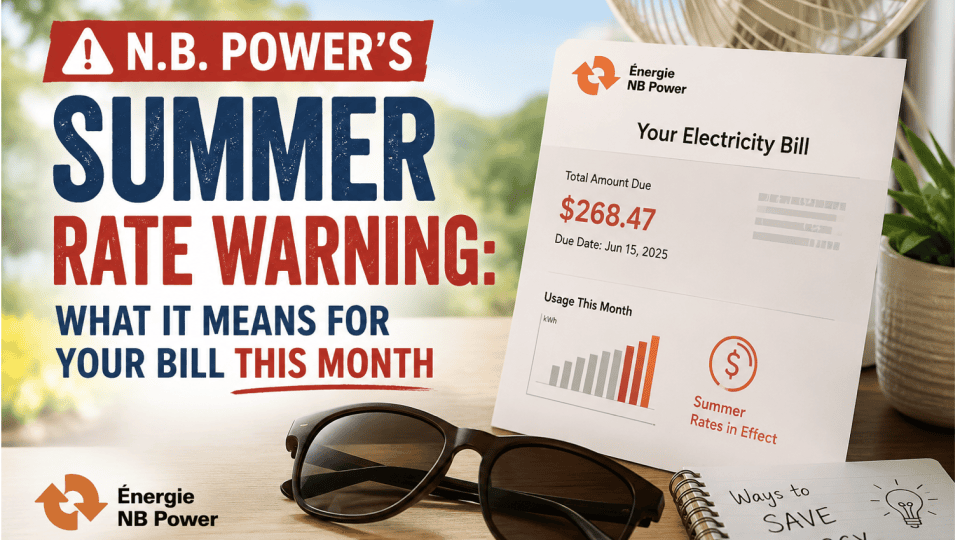
If your N.B. Power bill has felt heavier lately, you’re not imagining it. Between a rate increase that landed this spring and the extra load air conditioners and fans put on your meter in the heat, this summer’s bills are stacking two cost pressures on top of each other. Here’s what’s actually driving the numbers and what you can do about it before your next statement arrives.
The rate hike behind the higher numbers
New Brunswick’s electricity rates jumped 4.29 per cent on April 14, 2026, after the Energy and Utilities Board issued its final decision on N.B. Power’s general rate application. The residential rate moved from 14.76 cents per kilowatt-hour to 15.39 cents per kilowatt-hour. For an average household using 1,350 kWh a month, that works out to roughly an extra $9.83 on the monthly bill.
Because rate changes don’t line up neatly with billing cycles, many customers saw the increase phased in gradually across two billing periods rather than all at once — part of why the jump on a given bill can look bigger or smaller than expected depending on when your meter was read.
This increase came after a longer, more contentious process than usual. N.B. Power had originally asked for a 4.75 per cent hike and even sought an interim increase starting April 1, warning that a delay would hurt its finances. The board rejected the interim request, then approved a scaled-back 4.29 per cent increase weeks later. It’s also smaller than the two previous years’ increases, which had approached 10 per cent — though N.B. Power has signalled further hikes of around 6.5 per cent are planned for the next two years as it works down a $5.7-billion debt load and pays for aging infrastructure repairs.
Why summer adds its own pressure
Even without a rate increase, summer bills tend to run higher than people expect, and the reason is almost always cooling. Air conditioning can account for a large share of a home’s summer electricity use, and that share climbs fast as the outdoor temperature rises. Cooling a home to 75°F when it’s 95°F outside can take roughly three times the electricity needed on a milder 85°F day. A heat wave doesn’t just nudge your bill up a little — it can meaningfully multiply your cooling costs for as long as the hot stretch lasts.
Combine that seasonal effect with the new rate, and this month’s bill is really doing double duty: a higher price per kilowatt-hour, applied to more kilowatt-hours than you’d use in spring or fall.
What you can do about it this month
- Close blinds and curtains during peak sun hours, especially on south- and west-facing windows — this can cut heat gain substantially.
- Shift heavy appliance use to early morning or evening, keeping dishwashers, laundry, and other big draws out of the hottest part of the afternoon.
- Check air filters and vents. A clogged filter makes an AC or heat pump work harder for the same result.
- Use fans to supplement, not replace, your cooling system — they use a fraction of the electricity and can let you raise the thermostat a few degrees comfortably.
- Watch for anything drawing power unnecessarily, from lights left on in empty rooms to electronics running in standby.
The bigger picture
Advocacy groups like the Human Development Council have raised concerns throughout this rate process about energy poverty in New Brunswick, noting that a significant share of households already spend more than 6 per cent of their pre-tax income on power. With more rate increases expected over the next couple of years, this summer’s bill is likely a preview of a broader trend rather than a one-time spike. Keeping an eye on both your usage habits and N.B. Power’s regulatory filings is a reasonable way to stay ahead of what’s coming.
Want me to try saving this as a downloadable file again in a moment, or would you like it adjusted in tone/length first?

