


It’s easy to spot the tick researchers at work. They’re wearing “the new Maritime fashion,” one of them jokes.
“Socks tucked up over your pants,” Laura Ferguson said, laughing.
Ferguson, a biologist and professor at Acadia University, is leading these research efforts, the first of a five-year tick surveillance project in Nova Scotia.
On this July morning in Kentville, Ferguson and two of her summer students are preparing for a morning of tick collecting.
Since they’re trying to attract ticks, they can’t wear bug spray. The tucked-up socks, light-coloured clothing and a thorough check afterward are their main precautions.
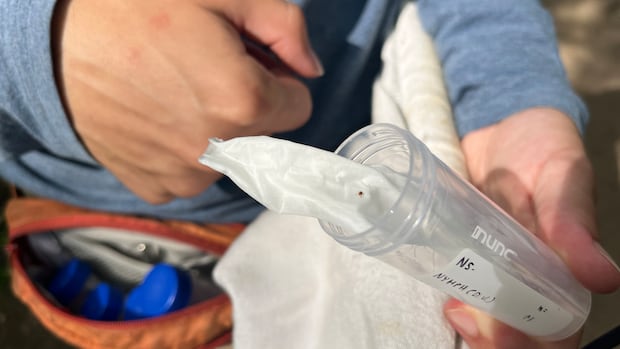
Students Connor Smith and Hannah Lay walk on either side of a wooded trail, dragging a piece of white fabric behind them on the ground. Every 25 steps they stop and hold up the cloth for inspection.
At first Smith doesn’t see anything. But then he spots a juvenile, so tiny, it’s easy to miss.
“Those nymphs are the size of sesame seeds,” he said. “They’re hard to see. With tweezers, he grabs its back legs and drops it into a vial.
Nymphs are often implicated in the spreading of tick-borne illnesses, according to Ferguson.
“Because the nymphs are so small, as you just saw, they’re more likely to go undetected on the body of either a person or a pet,” she said.
LISTEN | Maritime tick research got more serious after a tick bit a scientist:

Atlantic Voice26:10A tale of two generations of Maritime tick science
Tuck your pants into your socks, » Read More
This story was brought to Nouzie by RSS. The original post can be found on https://www.cbc.ca/news/canada/new-brunswick/tick-research-vett-lloyd-laura-ferguson-9.7348453?cmp=rss

