



Quick Summary: Starting a Local Business
- Start by completing the business registration process so you can operate legally and confidently.
- Research the local market to confirm demand, understand competitors, and spot clear opportunities.
- Build a focused business plan that defines your services, pricing, operations, and growth goals.
- Engage with the community through local relationships and events to earn trust and visibility.
- Explore small business financing options to fund startup costs, manage cash flow, and support expansion.
Build Your Local Business From Idea to Poster
This process helps you turn a business idea into a real, legal setup and a clear public announcement. For New Brunswick residents who rely on timely, diverse local news and community event updates, it also helps you share your opening or event in a way that local channels can quickly understand and circulate.
1.Validate one problem worth solving
Start by listing a few options, then pick one idea to test with real people who would buy it. Use customer interviews or a simple waitlist to confirm demand before you spend on inventory, signage, or ads.
2.Choose a name and confirm you can use it
Pick a business name that says what you do and is easy to repeat out loud. Search online and locally for confusingly similar names, then decide whether you will operate under your personal name or a registered business name for credibility and consistency.
3.Register your business and handle basic setup
Register the business name and choose a simple structure that fits your situation, then open a dedicated business bank account once you have the paperwork. Keeping business money separate makes taxes, pricing, and cash flow easier to track from day one.
4.Secure the permits and approvals you actually need
Make a short checklist of what you sell, where you sell it, and whether you will serve the public in person, then confirm the permits that apply to those specifics. Getting approvals early prevents last minute delays when you are ready to announce your launch date.
5.Plan your event message, then make a print-ready poster
Decide what you want your event to achieve and who it is for using define your event goals, target audience, key messaging as your filter for every promo choice. Then draft a one paragraph announcement and turn it into a clean DIY poster with only the essentials: what, when, where, price, and a phone or QR code, saved as a high quality PDF for printing, with many people finding that using a printable poster maker helps keep the layout simple.
Plan → Connect → Share → Learn
This workflow turns your launch into an ongoing community presence, so neighbors hear about you more than once and in more than one way. For New Brunswick residents who follow timely, diverse local news and community event updates, it also keeps your information easy to reuse across calendars, community pages, and word of mouth. Treat it like a loop you repeat every week, not a one time push.
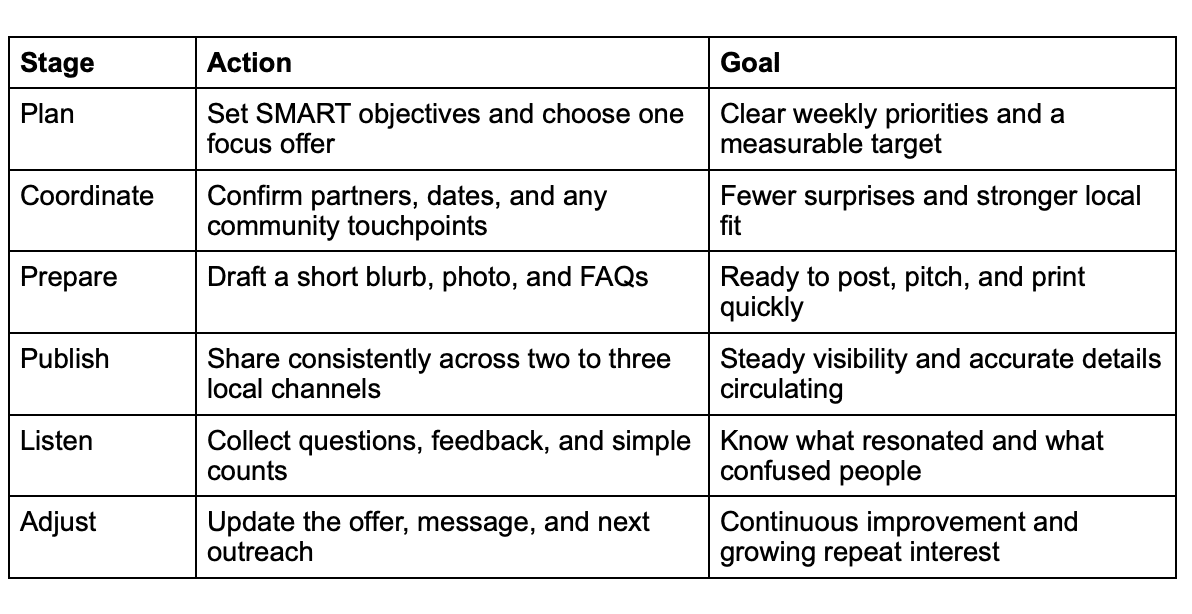
Visible Network Labs suggests teams can set objectives using SMART objectives, which makes the loop easier to track week to week. Over time, planning and publishing become faster, while listening and adjusting keep you relevant as community needs shift.
Make a Real Local Impact While Spreading the Word
- Strong local marketing doesn’t have to feel “salesy.” When you connect your business to real community benefit initiatives, your outreach becomes part of the neighbourhood conversation, and that’s where steady growth comes from.
- Pick one cause and commit to a simple, visible habit: Choose a community need that fits your business (litter cleanups, youth sports, food security, arts programming) and set a small baseline you can repeat, like 2 volunteer hours per month, a monthly in-kind donation, or a “round up at checkout” day. Consistency is the point: it’s easier for people to remember (and trust) a pattern than a one-time gesture. Many owners already show up this way, and volunteering their time is a common form of small business social responsibility.
- Show up at local events with a “help first” role: Instead of buying the biggest booth, aim for the most useful task: run a water station, lend equipment, offer a quiet “charging corner,” or sponsor a small prize for a community raffle. Pick one recurring event type to start (markets, tournaments, school fundraisers), then Plan what you’ll bring, Connect with organizers, Share a few photos afterward, and Learn what got the best conversations.
- Turn word-of-mouth into a repeatable system: Train yourself and staff to ask one clear question at checkout: “Who are you shopping for today?” If the answer signals a group need (teacher, coach, new neighbour), offer a small, relevant extra and ask for a simple referral: “If you liked this, tell one friend who’d use it.” Keep referral rewards modest and community-minded, like “bring a friend, both get 10% off” or “refer a neighbour, we donate $5 to a local program.”
- Create micro-partnerships that make customers the hero: Reach out to 3 nearby organizations that serve your ideal customers, sports clubs, community theatres, environmental groups, tech meetups, and propose a small collaboration you can run in two weeks. Examples: a co-hosted “members night,” a limited-time bundle with a partner business, or a joint workshop where attendees get a practical takeaway. This supports the Connect stage and often leads to natural cross-promotion without feeling like an ad.
- Run “local visibility” campaigns with one clear goal at a time: Choose a single objective for the month, foot traffic, bookings, newsletter signups, and build a small campaign around it: one offer, one landing page or sign-up sheet, and one weekly reminder post. Businesses often see stronger awareness when they invest in local visibility campaigns, so keep it simple and track one metric (calls, walk-ins, or signups) to learn what’s working.
- Use community storytelling to earn trust (and improve your offer): Once a week, Share one short story that highlights your values: a customer win, a behind-the-scenes fix, a community partnership, or a learning moment. Keep it specific, what happened, what you changed, what it means for locals, and invite feedback with a single question. Those answers become your Learn stage: they tell you what to improve and what people are already telling their friends.

Turn Community Needs Into Your First Business Momentum
Starting a local business can feel risky when money is tight and you’re unsure where to begin or who will show up. The steadier path is community-focused entrepreneurship: listen first, start small, and keep building trust through consistent service and visibility. Do that, and entrepreneur motivation turns into real progress, early customers, stronger word-of-mouth, and confidence from those first business steps. Start small, stay visible, and let your community guide your growth. Choose one action this week: book a free chat with supportive business resources, or ask one local owner about their local business success stories. That’s how New Brunswick grows more resilient, one helpful business at a time.
Written by:
Joe Ress

