


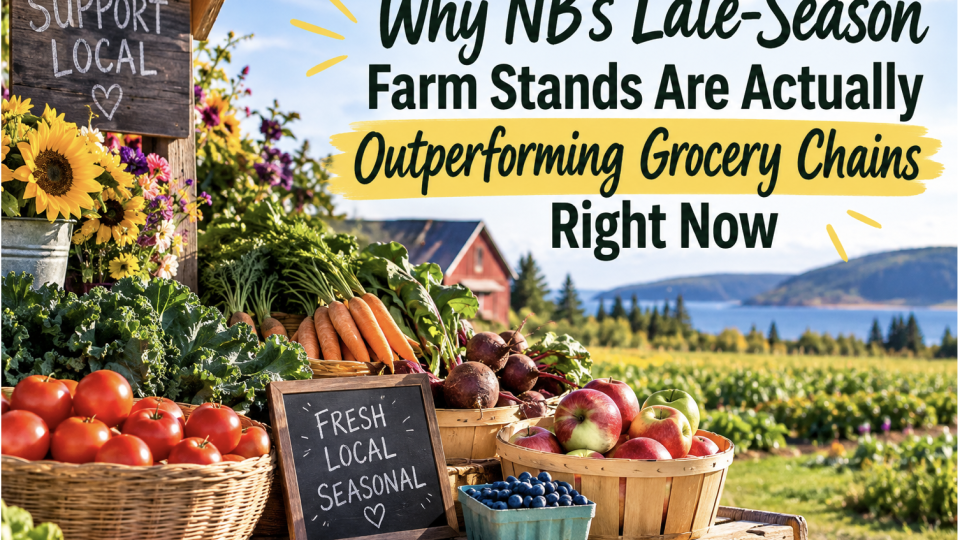
Drive any secondary road in New Brunswick this October and you’ll see them: hand-painted signs, a wagon of squash, a cooler of carrots, an honesty box with a coffee can for cash. They’re easy to read as nostalgia. This year they look more like a better deal.
I couldn’t find current-season sales figures for farm stands, so “outperforming” here means price stability, freshness and value. On those measures the case is strong.
The price gap has been building for years
One New Brunswick farm, Ferme Terre Partagée, shared data showing its food box prices rose 6.7 per cent over seven years, compared with an increase of more than 30 per cent at New Brunswick grocery stores. That’s one farm’s numbers, not a province-wide study, but it matches what many shoppers feel at the checkout.
The grocery side has been rough. A Statistics Canada-based analysis found New Brunswick had the largest year-over-year food price increase in Canada between May 2024 and May 2025, at 3.7 per cent against 3.4 per cent nationally. That’s older data, but it shows where the province’s grocery prices have been heading.
Fall is when local produce shines
Late-season crops are what farm stands do best: potatoes, carrots, beets, cabbage, onions, squash, apples, turnips. These are field crops grown here, harvested close to the day you buy them, with no long supply chain between the field and your cart.
Grocery chains are the opposite for much of the year. Nearly all fruit and vegetables consumed in Canada are imported, which makes them more vulnerable to swings in the Canadian dollar. A farm stand selling potatoes dug last week doesn’t carry that exposure.
Fewer middlemen, more of your dollar to the grower
Some of the farm stand advantage is structural. Farmers who sell direct skip the wholesaler and the retail markup. Some farmers have also argued that so few companies control Canada’s grocery system that farmers have little room to raise prices. Selling at your own stand lets a grower set a fair price and keep the margin.
Farming is not cheap. Producers have been dealing with rising costs for fuel and inputs, and one NB grower who sells both wholesale and at a roadside stand has said his production costs had doubled in a year and that stand prices might have to rise. A stand is not automatically cheaper on every item. It often is on in-season staples, and your money goes further toward the person who grew the food.
Where grocery chains still win
- Selection. No stand will sell you coffee, citrus or cheese.
- Hours and convenience. Stands close early and shut down when the weather turns.
- Year-round supply. After the first hard frost, the stands go quiet.
- Some items. Buy-in-bulk staples and sale items can still be cheaper at a chain.
The smart approach is a split cart, not a boycott. Farmers themselves have pointed out that dropping corporate grocers entirely isn’t realistic in a rural province, and that New Brunswick doesn’t have enough producers to feed everyone.
How to shop a farm stand this fall
- Buy the staples there. Potatoes, carrots, onions, squash, cabbage and apples are usually the best value.
- Buy in bulk. Root vegetables store well. A 10-pound bag of potatoes or carrots in a cool, dark spot lasts for months.
- Bring small bills. Many stands run on cash or e-transfer.
- Compare unit prices. Check against your usual store’s per-pound price for the same item.
- Go before the first hard frost. After that, selection thins fast.
The bottom line
Farm stands won’t replace the grocery store, and they’re not a magic fix for food inflation. For late-season produce, though, they offer fresher food, steadier prices and more of your money going to a New Brunswick grower. If your grocery bill has been hurting, it’s worth a Saturday drive.

