


March 5, 2026
If you’re a longtime subscriber, you likely know I’m a big fan of solar energy – and that we had two six kilowatt grid-tied solar arrays installed at our home, in 2020 and 2023.
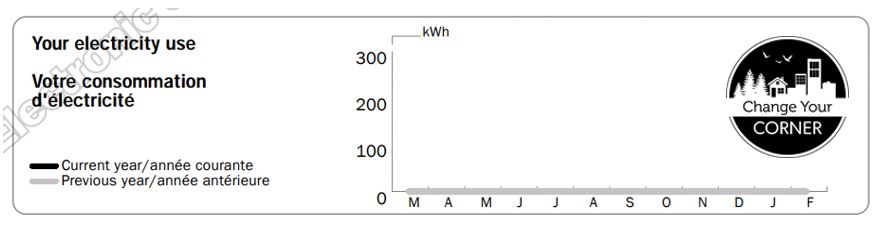
Well, this month marks a milestone worth celebrating: two years that our arrays have produced 100 per cent of the electricity used to power our home and charge our EV. In other words, two years since we’ve had to buy a single kilowatt-hour of electricity. Power bills in New Brunswick have a nice graph showing one’s consumption over the past two years, and this is what two years of solar looks like for us:

In the world of health, a flatline is a bad thing – but in the world of energy consumption, it’s actually quite the opposite.
I’ll hasten to add a few relevant points of clarification, though:
- We heat primarily with wood, and that’s a key to the above flatline. If we heated with electricity, we’d definitely need more panels to achieve net-zero.
- We’re grid-tied and net-metered. That means we can push surplus power into the grid in summer and build up a credit we can then use in winter. That’s a great solution for us, but not as great for our power utility, because the kilowatt-hour we get back in winter isn’t the same one we sent in summer; it has to be generated (because grid power is used the instant it’s generated), and that can add to heavy winter loads on the grid.
- That’s why in the longer term, energy storage is key to taking the ‘intermittent’ out of solar. Battery technology is changing rapidly and prices are falling sharply every year, so the day is not far off when the sun’s energy can be stored in a battery – whether a home battery, an EV (some have that capability now) or a grid-scale battery – for later use.
Still, perhaps what solar has done at our home can serve as an indication of the potential of solar for many of us, and for our province:
- Every kilowatt-hour generated locally from the sun is one less that needs to be generated from imported fuel. That keeps more money in our local economy, and insulates us from the volatility and political turmoil of the fossil fuel world.
- In the hopefully-not-too-distant future, those without a suitable location for solar will be able to invest in or buy power from large nearby community-owned arrays.
- In the hopefully-not-too-distant future, financing of panels will become easier too, through better incentives and adoption of innovative financing tools like Property Assessed Clean Energy (PACE). Incentives are a bit rare at present, though Save Energy NB still offers $200/ installed kilowatt of panels.
- Getting to net-zero with solar isn’t possible for everyone because of issues like roof size, roof orientation, shading and more – but every single panel installed takes a nibble out of a power bill, and many nibbles can add up to a big bite.
And of course, zero-emission solar will help us meet our net-zero targets!
Solar does require a bit of upfront investment, but once installed the fuel is free, forever. So why not consider it, for your own home, business or community? And don’t be shy about encouraging your politicians to support solar; there’s a global revolution coming, so let’s be part of it here too!
Questions about solar? Here’s a nice guide for homeowners; and here’s a guide to choosing an installer; or just shoot me an email!
Posted by carlsgreenideas
Filed in Uncategorized ·Tags: climate change, electricity, emission-free electricity, emissions, energy, environment, power, renewable-energy, save, save energy, solar, sustainability
This story was brought to Nouzie by RSS. The original post can be found on https://carlsgreenideas.wordpress.com/2026/03/05/what-solar-has-done-for-us-and-its-potential-for-all/

