

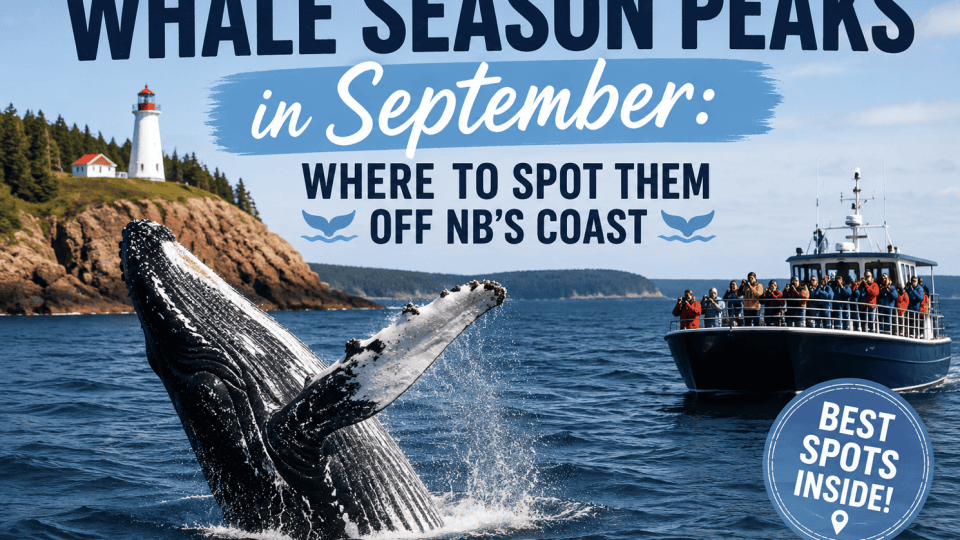
September is the quiet secret of New Brunswick’s whale-watching season. The summer crowds have thinned, the water is still warm enough to be comfortable on deck, and the Bay of Fundy — home to the highest tides on Earth — is teeming with whales fattening up before their long migration south. If you want the best odds of a sighting without the August rush, this is the month to go.
**Why September is prime time**
Through late summer and early fall, the bay’s cold, nutrient-rich waters draw enormous concentrations of krill, herring and sand lance. Whales follow the food. By September, several species are actively feeding along the coast, and the calmer weather typical of early fall means smoother crossings and better visibility. It’s a sweet spot: peak feeding activity, lighter boat traffic, and plenty of daylight left to enjoy it.
**Where to go**
– **Grand Manan Island** — The furthest offshore option and consistently the most productive. The waters around the island’s western shore are a known gathering ground for finbacks, humpbacks and minkes, and the island is a launch point for longer excursions into deeper water.
– **Campobello Island** — At the southern tip, Head Harbour Passage funnels currents (and baitfish) past the island, making it a reliable viewing area. Nearby, the Old Sow whirlpool — the largest tidal whirlpool in the Western Hemisphere — is worth a look on its own.
– **St. Andrews by-the-Sea** — The mainland’s main departure hub. Several operators run daily trips into Passamaquoddy Bay and the outer islands, and the town makes an easy base for a weekend visit.
– **Deer Island and the Passamaquoddy Bay** — A quieter, closer-to-shore option. Harbour porpoises and seals are almost guaranteed, with larger whales passing through depending on the tide.
– **St. Martins and the Fundy Trail** — Not a traditional whale-watching launch, but the cliffs and headlands give you a free shoreline vantage point, especially at high tide.
**What you’re likely to see**
– **Humpbacks** — frequent breachers, often the star of the show
– **Fin whales** — the bay’s largest regular visitor
– **Minke whales** — smaller and shyer, but common
– **North Atlantic right whales** — rare and critically endangered, but the Bay of Fundy is one of their key feeding grounds. If you’re lucky enough to spot one, boats keep a wide berth by law — roughly 400 metres — so bring binoculars
– **Harbour porpoises, seals and seabirds** — constant companions on any crossing
**Practical tips**
– Book a **morning departure** — seas tend to be calmest and wind picks up in the afternoon
– Dress in **layers**; even sunny days are cool on the water
– Take seasickness medication *before* you board if you’re prone to motion
– Bring **binoculars**, a telephoto lens if you have one, and a dry bag for your gear
– Respect the rules — operators keep required distances from wildlife, and those distances exist to protect endangered species
One conservation note: North Atlantic right whales number only a few hundred individuals, and every encounter in the bay is managed carefully. Choose a responsible operator that follows federal approach-distance regulations, and you’ll get a memorable trip that leaves the whales undisturbed.
September won’t wait. Pick a weekend, pick a harbour town, and get out on the water while the feeding frenzy is at its height

