


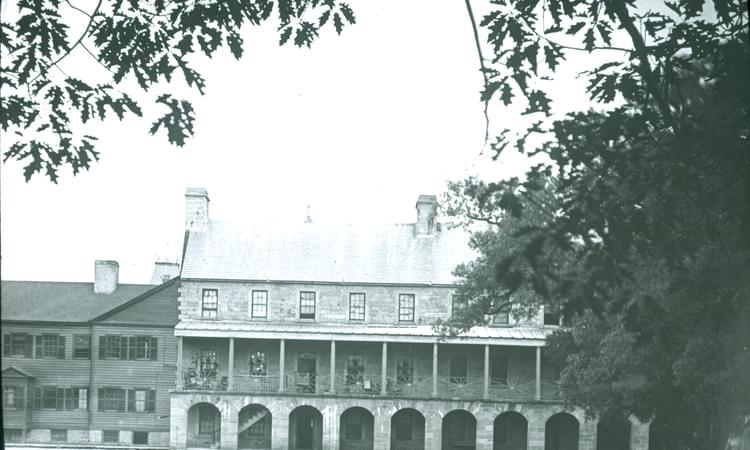
On Baltimore Street in Gettysburg Pennsylvania, there’s a sycamore tree under which Abraham Lincoln passed on his way to deliver the Gettysburg Address on November 19, 1863. Today, that tree, among numerous others in Gettysburg, is revered as a Witness Tree — The Lincoln Witness Tree — because it was alive, and hence part of a significant moment in US history.
In Officers’ Square, in Fredericton, the mature American elms, which could be more than 200 years old, have witnessed significant moments in Canadian history. It’s even possible that one or two of them were alive on February 14, 1813, when the officers and enlisted men of the 104th Regiment of Foot — The New Brunswick Regiment — gathered in the parade grounds beside the barracks, known today as Officers’ Square. It was the height of the War of 1812, and the troops were needed in Upper Canada to repel American incursions across the border.
On that bitterly cold afternoon, as the regimental band played The Girls We Leave Behind Us, a favourite tune of the day, many of the more than 550 men were thinking about the long march to Kingston, which was to begin two days hence. Known today as the March of the 104th, the 1100-kilometre, 52-day trek in harsh winter conditions is considered by many to be one of history’s major military troop movements.
Trees are easy to take for granted, easy to overlook. Considering the passing of time and events they have witnessed, however, it’s imperative that we pay attention to them. They have much to teach us. First, though, we must learn to listen to their music — the music beyond our hearing. When the leaves rustle, that’s the anthem of nature we hear, the hymn of the universe.
To celebrate the music of the trees, Fredericton pewtersmith Martin Aitken created a piece of jewellery a few years back called The Music of the Trees Brooch.
“I came up with the idea during Harvest Jazz and Blues,” Aitken said. “After walking around town all evening listening to music, I sat down under the big elm beside the museum in Officers’ Square. Looking up, I watched its branches gently swinging and swaying in the autumn breeze. Closing my eyes, I listened carefully to the sound of the rustling leaves and how beautifully it mixed with the music coming from throughout the downtown.”
Aitken believes that Fredericton’s downtown trees are the repositories not only of the collective memory of the city’s history but also of its rich musical heritage.
Naturally, that musical heritage includes the almost three decades of remarkable music from the Harvest Jazz and Blues Festival, but it’s a lot more than that. For centuries the choir voices of Fredericton’s many churches lifted the spirits of the city’s residents. At one time, there were so many churches, Fredericton was known as the Celestial City. The canopy of elms that has covered the downtown for centuries only adds to that “celestial” feeling. For those early residents, heaven was “up there” just beyond the cover of green.
In June 1939, the big elms in Officers’ Square witnessed the visit to Fredericton of King George VI and Queen Elizabeth. A 12-year-old girl watching that day remembered the pomp and circumstance of the event, including the music. “The king and queen looked like bronze statues, as they motored along Queen Street,” she recalled years later. That royal tour, which began in Québec City, marked the first time a reigning Canadian monarch stepped foot in Canada. As the royal couple passed Officers’ Square, the sound of bagpipes and the steady rhythms of a military band floated up into the trees, where the notes remain for those who choose to listen.
And what about the night Louis Armstrong played the Fredericton armoury in the late forties? Those big elms in Officers’ Square and throughout the downtown would have witnessed the sweet sound of Satchmo’s remarkable trumpet — pure genius!
But there is the music of conversation too, conversations those elms would have witnessed. The older trees may well have heard William Cobbett complaining about the lack of good beer locally. Cobbett, the unit regimental sergeant major, who was stationed in Fredericton from 1786 to1791, would go on to become a member of parliament in Great Britain and play a significant role in parliamentary reform. He’s also considered one of the fathers of modern journalism.
And what would those American elms have heard as Oscar Wilde roamed around the downtown on October 3, 1882, speaking with locals he met on the street. That evening those same trees would have heard people discussing Wilde’s lecture on the decorative arts as they walked home from the concert hall, which today is Fredericton City Hall.
In 1965, what did the elms hear as they witnessed Winston Churchill walking in the downtown with his old friend Lord Beaverbrook? One can only imagine. Perhaps they discussed the new John F Kennedy memorial in Officers’ Square and the assassination of the American president. Kennedy visited Fredericton in October 1957 to receive an honourary degree from UNB.
As we all keenly await those hot, lazy days of summer and the next Harvest Jazz and Blues Festival in September, let’s pay closer attention to our Witness Trees and the music they hold in their leaves and branches. Let’s honour them and share with the world the music and history they have absorbed over the centuries. After all, there’s music in those trees when the leaves rustle. It’s the hymn of the universe — the anthem of nature.

