


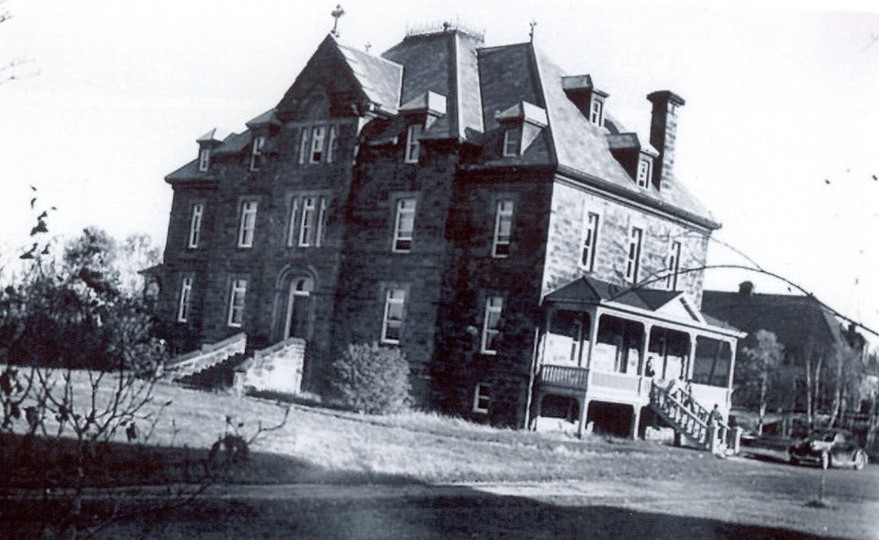
How The Years Have Told Us What The Days Never Knew:
A Limited And Selective Review of
Church, Politics, and STU: The Relocation of St. Thomas University from Chatham to Fredericton
Given the Roman Catholic Diocese of Saint John’s revitalization and realignment exercise there is no better time to reflect upon William Spray and Anthony Rhinelander, Church, Politics, and STU : The Relocation of St. Thomas University from Chatham to Fredericton (Fredericton : St. Thomas University, 2014).
St. Thomas University in Chatham was constitutive of the religious heart of the Miramichi region which at the time was the school at which many young men and women found their vocation to religious life. It is now perhaps viewed as a story from another era but I contend that it is instructive to consider what was gained and especially what was lost by this “move”.
As a story of what now has become a relatively successful modern liberal arts school, the book sheds a certain light on the “move” and its causes and consequences. As a history, it perhaps is the best and most thorough account to date. And if one is interested in the story and issues of the time and of the Diocese now going through a major and even wrenching physical and spiritual restructuring, it is highly recommended.
History alone, however, is not enough for there is much in this story that cannot be captured by its method. And here I am speaking of the issue of the school’s original Catholic identity. How has it fared in the move? This question focuses very quickly on the philosophical and theological issues at stake in the story. For these things can only be adequately captured by the perspective of philosophy and theology, involving an intellectual dialectic and history of a certain nature and quality.
The appearance of this book is an occasion to speak of these things again, at least briefly. So I write as a native of the Miramichi, who as a youth and young student lived through the painful “transition” of the STU of the Miramichi to the STU of Fredericton. I am also a Catholic-Christian who taught philosophy part-time at STU in Fredericton from 1995-2003. I say these things to clearly present my bias and interests in this short review and reflection.
For a time in the mid-fifties, there was considerable concern over the role of philosophy in Catholic colleges. The question was this – ‘if the Christian mission, even in its schools is, in the language of the fifties, the salvation of souls, why is philosophy needed? This of course was the resurfacing in some sense of a very old question for the early Church in its confrontation with Greek philosophical wisdom.
Two responses were proposed – a) eliminate philosophy or b) bring it under the watch of theology to ensure it keeps to its proper role and path. There was also the very astute question raised by Thomists at the time, as to what happens to theology without philosophy? This was 1955, over 60 yrs ago.
Today the question has shifted radically from ‘what happens to theology without philosophy?’ to ‘what happens to philosophy without theology?’. This, I believe, is a very rich area of enquiry having to do with the important relationships of faith and reason, and of theology and philosophy … an area where Thomism has been very strong historically and, in my view, remains so.
At STU of the Miramichi, the answer to the 1955 question ‘what happens to theology without philosophy?’ could be put quite simply in Miramichi terms – ‘it loses its mind!’
The second part of the question would never have arisen on the Miramichi, but does have to be asked of the STU of Fredericton (2017) – ‘what happens to philosophy without theology?’ … and the answer, I suggest, is ‘it loses its heart!’
This does lead loosely into the question of charity – for we are to do all things with charity and so to teach with charity, especially in the face of misdeeds done by all of us, and so often in ignorance ‘through no fault of one’s own’.
However, the simple and strong message of our theology is this – that ‘God has addressed us’, that ‘God is addressing us’, through both creation and history, in our very existence which is both a gift and response, in both act and form.
Pope John Paul II’s encyclical Fides Et Ratio (1998), as a continuing line of instruction and exhortation by the institutional Church in this matter of the proper relation of faith and reason, characterizes this issue as a question in which we are not to lose hope but neither, in Miramichi terms, are we to lose our ‘horse sense’. Things are happening, things are going forward, and not all for the good. And for the sorting of this out, we need both good philosophy and good theology – philosophy for the sorting, and theology for the charity in doing so.
What this comes down to, in my humble assessment, is that in our dialogue with others in the contemporary pluralistic context, we cannot as Christians betray what we have been given. In my view, this has happened over time at the STU in Fredericton, at least in terms of the school’s Catholic-Christian identity. The Spray-Rhinelander history provides the account.
As for what happened in the ‘move’, there was no betrayal by the actual STU community of the Miramichi at the time or by the larger surrounding community of the Miramichi. Instead, what gift this community had been given and had nurtured in this little school, though it may not have always been cared for in the most effective manner, was actually taken from it if not stolen outright. And it was done at a time when things were looking quite promising for the school on the Miramichi, where enrolment actually had reached over 400 students, though it was erroneously reported at the time by enthusiasts of the modernizing prospects of the ‘move’, as only 200 students. Since the ‘move’, however, this gift carried by this little school for the sake of the local Church and culture, simply put, has died.
Again, we can and must acknowledge that STU has become a relatively successful liberal arts school. But as for its Catholic-Christian identity … there is a proud heritage that remains, there are vital remnants that remain, one may hope, but this is very different from an actual living community that is Christian – that is gone. And for many, it is viewed as nothing less than a tragic loss.
It also must be said in charity, that much was done in ignorance both within the local Church and without, and much has been done by many since ‘through no fault of their own’.
Nonetheless, the tragedy of the affair, from the Catholic-Christian perspective of the school’s Catholic identity, must be owned up to by both common ‘horse sense’ and because we have no intention of ‘loosing our minds’, though as Miramichiers, our hearts were broken.
Hugh Williams, PhD
[All images courtesy http://wp.stu.ca/stuhistory/photo-archive/]

