


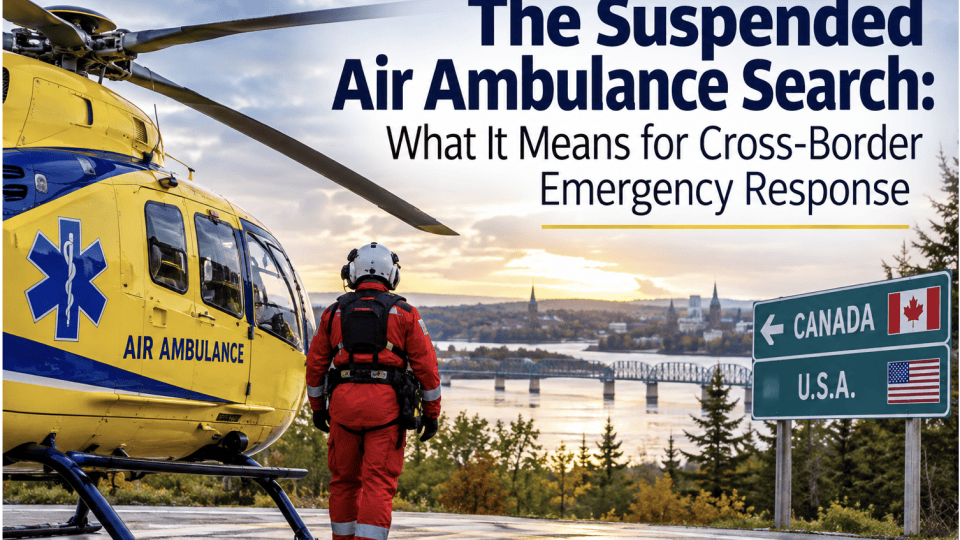
In early October, a Canadian-registered air ambulance disappeared off the coast of Massachusetts. The U.S. Coast Guard suspended its search for the six people aboard after about 66 hours of searching by air and sea, once debris off Nantucket was confirmed to be from the aircraft. The plane was operated by Latitude Air Ambulance of Hamilton, Ontario. It was carrying two pilots, two medical staff, a patient and a relative on a flight from Bermuda to Boston, and the company said all six were presumed dead.
The loss of the crew and the family who were aboard is a tragedy first. It is also a reminder of how many emergency flights cross borders, and of how much of that response is shared. For New Brunswick, that raises some practical questions.
A Canadian aircraft, an American search
The Nantucket search was led by American agencies. The Coast Guard worked with the New York National Guard and Massachusetts authorities across roughly 7,350 square kilometres. The investigation is cross-border too: Latitude said it would work with the U.S. National Transportation Safety Board and the Transportation Safety Board of Canada.
That is the model New Brunswick would rely on in a similar emergency. Our geography is full of borders that emergency planning has to cross. The Bay of Fundy and Gulf of Maine have no line on the water. Campobello Island’s only road link runs through Maine. And the province’s maritime search-and-rescue coordination runs through the Joint Rescue Coordination Centre in Halifax, which oversaw the helicopter search for a missing boater on the Saint John River in Long Reach. A search that begins in one jurisdiction can end in another, and the quality of the handoffs matters.
“Suspended” is a decision, not a failure
Searches are suspended when the likelihood of finding survivors falls to the point where continuing is no longer justified. Rear Admiral Matthew Lake said suspending a search is not an easy decision. Even then, the work continues in another form, with recovery and investigation taking over.
For New Brunswick communities, the point is that a search timeline is limited by survival odds in cold water, weather and daylight. That is why the speed of the initial response matters so much, and why reliable local air capacity matters more than any single dramatic rescue.
New Brunswick has already learned this lesson on Grand Manan
The province’s most vivid recent example of fragile air medical coverage is Grand Manan. The island’s previous air ambulance was grounded after new federal rules on pilot rest and flight times took effect in December 2022, and talks between Ambulance New Brunswick and Atlantic Charters failed to produce an agreement before the deadline. The gap lasted nearly two years.
The consequences were real:
- The military had to step in twice in two months to provide air ambulance service to the island, including one operation where a helicopter flew in from Greenwood, N.S., after fog stopped Ambulance NB’s plane from flying.
- In May 2024, two aircraft could not transport a stroke patient because of severe weather.
- Islanders rallied for a solution, and some described emergencies made more critical, in some cases fatal, by the lack of service.
The fix eventually came. An island-based King Air 200, operated by Voyageur Aviation and Ambulance NB, made its first patient transfer after arriving on the island, with improved ability to operate in poor weather. The mayor called it the community’s biggest achievement of the year.
What the two stories share
The Nantucket crash and the Grand Manan saga are very different events, but they point to the same underlying issues:
1. Air medical transport is safety-critical infrastructure. It depends on regulation, pilot staffing, aircraft maintenance and weather margins, and a weakness in any one of them can cut off a community’s access to care. The federal pilot-fatigue rules that grounded the old Grand Manan service exist for a reason: fatigue is a known aviation risk. The lesson is that safety rules need funded, planned implementation, so they don’t create gaps in coverage.
2. Redundancy saves lives. Grand Manan’s difficult period showed how much New Brunswick leaned on backup aircraft and military helicopters. Cross-border and inter-agency cooperation is part of that same layered system, and it only works if it is rehearsed and well coordinated before a crisis.
3. Geography makes coordination non-negotiable. An island in the Bay of Fundy, a fishing vessel in the Gulf of Maine and a patient on a long-distance medevac flight all depend on agencies that may sit in different provinces or countries communicating quickly.
Questions worth asking
New Brunswickers and their elected officials could reasonably ask:
- How are joint exercises with U.S. partners, especially Maine-based agencies and the Coast Guard, carried out and funded?
- What backup exists when the primary air ambulance is down for weather, maintenance or crew limits?
- How will lessons from the Nantucket investigation, once published by the NTSB and the Transportation Safety Board of Canada, inform provincial oversight of contracted air medical operators?
- Are island and border communities included in planning, rather than consulted after a service fails?
Bottom line
The suspended Nantucket search is a reminder that emergency response rarely respects borders and that every suspended search ends with families waiting for answers. For New Brunswick, the useful response is to treat air medical capacity and cross-border coordination as core public safety infrastructure, funded and tested accordingly. Grand Manan has already shown what happens when the plan falls short.

