

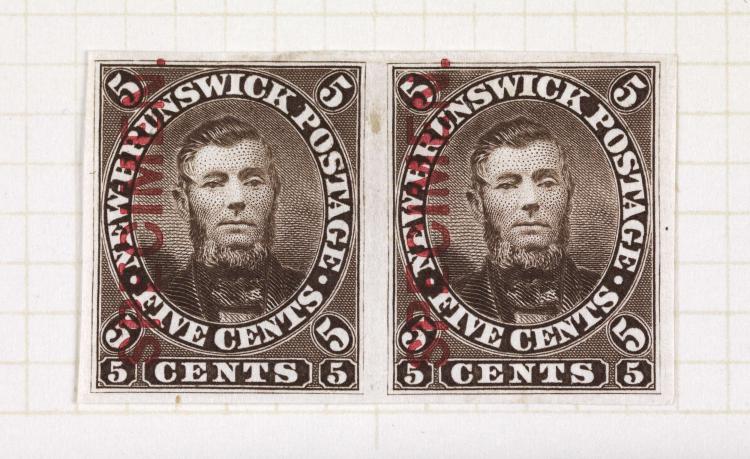
On a December morning in 1859, a heavy-set man with a thick black beard made his way up the front steps and through the heavy oak door of the American Banknote Company in New York City. Before that day was over, the man was to have made a decision that would forever enshrine his name in New Brunswick history and make a New Brunswick stamp the envy of philatelists around the world.
During the late autumn of 1859, the New Brunswick Legislature abandoned Great Britain’s system of currency in favour of the decimal system. But the British colony needed more than just new currency; it needed new postage stamps. At that time, the American Banknote Company alone produced postage stamps and currency for the North American market.
The responsibility for procuring the new stamps fell on the shoulders of one of the ablest men in government at that time; Postmaster General Charles Connell of Woodstock.
It was close to Christmas when Connell arrived in New York City. As usual, the largest metropolis in America was pulsating with Yuletide excitement. Horace Greeley’s New York Tribune was filled with speculation over how President James Buchanan would deal with the volatile issue of extension of slavery into the American territories.
Interesting as it was, the slavery issue was not on Connell’s mind as he walked through the ornate doorway leading to the American Banknote Company. He was preoccupied that morning with his impending meeting with company officials to decide on the design of New Brunswick’s new one, five, 10 and 12-and-a-half cent stamps.
In April 1860,the new stamps were finally delivered to the New Brunswick Cabinet. Since these were the first issues based on the new currency, everyone was filled with anticipation as they were presented. When the five-cent stamp was unveiled, a hush fell over the room; rather than the traditional likeness of the monarch, it bore the portrait of Charles Connell.
An uproar ensued and condemnation was unanimous. It was scandalous, said the distinguished members of Cabinet, that a commoner would dare replace the likeness of Queen Victoria with that of his own. To uphold the dignity of the colony, which they felt Connell had compromised, they ordered the stamps not go into circulation. Indignant over their response, Connell resigned from Cabinet and purchased the 500,000 stamps.
Despite his audacity, Connell’s political career was not ruined. He was still a member of the Legislative Assembly, and in the general election that followed Confederation in 1867, was elected to represent Carleton County in Ottawa.
As for the stamps, legend has it that most of them were destroyed. We do know, however that a few remained. Late in her life, one of Connell’s three daughters, Alice Garden, who lived in Victoria, B.C., wrote a letter to her sister Ella Dibblee in Woodstock:
“I have been asked many times if I had any of the stamps…As you know, I have a whole sheet as you have. But I do not think that we should make money out of something that caused our dear father so much mental anguish. I have burned mine, I pray that you will burn yours.”
In the 1930s, noted New Brunswick author, George Frederick Clarke, discovered two attached Connell stamps on the dirt floor of an old shed (behind the Dibblee house) in Woodstock. As it turned out, these two “Connells”, believed to be the only attached stamps left from the original issue, are the most prized of the 20 or so stamps that still exist. After holding on to them for a few years, Dr. Clarke sold them to Dr. Lewis Reford of Montreal who later sold them to another collector.
In an article in the November 1963 issue of The Atlantic Advocate Dr. Clarke explained:
“On November 7 and 8 [1963], the eyes of the philatelic world will be focused on a pair of New Brunswick postage stamps, known as Connells with a present catalogue value of $2,100 dollars…The scheduled sale of these stamps has already received wide publicity in the press of two continents; again revived the old scandal created by the printing of 500,000 copies; again brought to the notice of countless readers the Province of New Brunswick and the little town of Woodstock, the home of Charles H. Connell.”
Through hard work, determination, talent and luck, many New Brunswickers have left their stamp on the province. But nobody has done it quite the way Woodstock’s Charles Connell did on that cold New York morning in December 1859.

