


Most visitors to Fredericton stick to the same well-worn path — Officers’ Square, the Boyce Farmers Market, a stroll along King and Queen Streets, maybe a pint at one of the downtown breweries. All perfectly good choices. But if you really want to understand this city — its bones, its character, what it was built on — you need to cross the Nashwaak River and spend an afternoon in Marysville.
Chances are, you’ve driven past it. You may not have even noticed you were there.
That would be a shame.
A Company Town Frozen in Time
Tucked into the northeast corner of Fredericton, Marysville is one of the most intact 19th-century mill towns in Canada. That’s not a local boast — it’s the reason Parks Canada designated it a National Historic Site in 1993. The whole neighbourhood, not just one building, is protected: the mill, the workers’ housing, the commercial strip, the mansions on the hill. All of it, still standing, still lived in, still breathing.
The story starts with one extraordinarily ambitious man.
In 1862, Alexander “Boss” Gibson — a logger from Charlotte County — purchased a modest property on the banks of the Nashwaak for £7,300. It came with a gristmill, a blacksmith shop, a general store, some rough houses for workers, and 7,000 acres of woodland. Gibson didn’t just run a business here. He built an entire world.
Over the next two decades, he added sawmills, a brickyard, a railway, and — in his most audacious move — commissioned a state-of-the-art cotton mill from the prestigious Boston architectural firm Lockwood, Greene & Company. Construction ran from 1883 to 1885. By 1900, the Marysville Cotton Mill was among the largest in Canada.
He named the town after his wife and eldest daughter. Both were named Mary.
Walking Through the Historic District
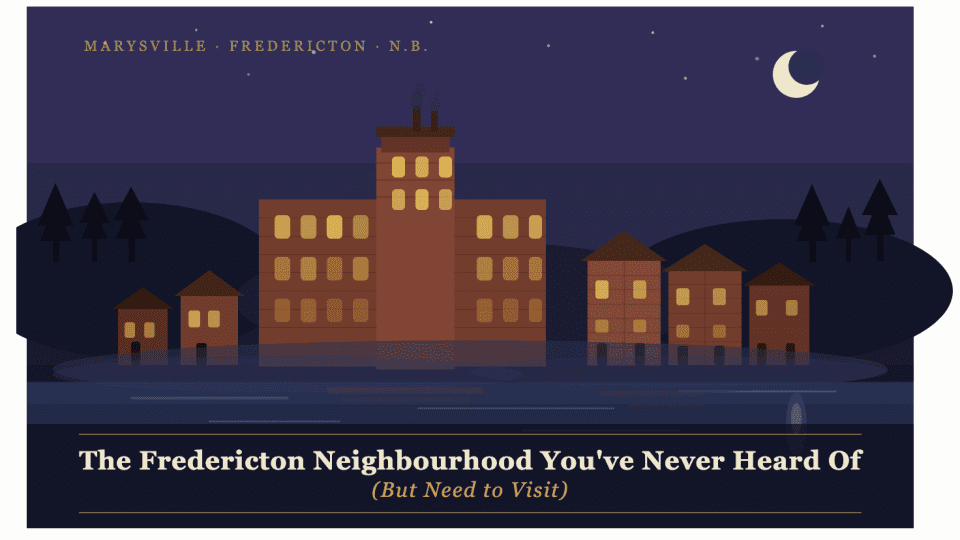
The cotton mill itself — now called Marysville Place and used as provincial government offices — is the first thing that stops you in your tracks. It’s an imposing four-storey red-brick structure stretching 418 feet along the east bank of the Nashwaak, crowned with a flat-roofed central tower and rows of multi-pane mullion windows that seem to go on forever. It was the first building in Fredericton to have electric lighting. It had a sprinkler system. For its era, it was extraordinary.
But the mill is just the anchor. What makes Marysville genuinely special is the surrounding landscape of workers’ housing — 39 brick duplexes in Italianate style, many still standing on the same streets where Gibson’s employees once lived. Walk along Bridge Street or Downing Street and you’re walking past homes that were built in 1889, still recognizable by their symmetrical brickwork, segmented arch windows, and uniform scale. The class geography is still legible in the architecture: workers’ housing on the low ground near the mill, managers’ homes climbing upward, and Gibson’s own mansion perched highest of all, up on what the town once called Nob Hill.
The Marysville Heritage Centre offers context for all of it — a small but thoughtful space that tells the story of the industrial boom that built this community, and the people who lived through it.
More Than a History Lesson
Marysville isn’t a museum town. People live here, raise families here, and the neighbourhood has a quiet, grounded energy that’s hard to find closer to downtown.
The Nashwaak River is right there, and it earns its keep. Locals fish it, kayak it, and tube it in summer. Riverside trails connect south through Devon to the Bill Thorpe Walking Bridge, which links Fredericton’s north and south sides on foot. If you like walking or cycling, you can follow the trail from Marysville all the way into the city’s core without ever getting in a car — and the views of the river the whole way are quietly spectacular.
There’s also Royals Field, a well-loved baseball diamond on Baseball Hill that’s been the gathering place for summer evenings since the Gibson era. Local baseball is alive and well here, and watching a game on a warm July evening with the brick duplexes in the background is the kind of experience that feels like it belongs to another, slower century.
Why Most People Miss It
Marysville doesn’t market itself. It doesn’t have a catchy slogan or a dedicated tourism app. It’s a neighbourhood, not an attraction, and that’s precisely the point.
But here’s what it offers that nowhere else in Fredericton does: the rare feeling of a place that was built all at once, for a single purpose, by a single extraordinary will — and then somehow survived. The cotton mill closed in 1975. Gibson’s empire is long gone. But the bones of his company town remain, still standing in the river fog, still telling the story of what it once meant to build something from nothing in New Brunswick.
Next time you’re in Fredericton, skip the fourth brewery. Cross the Nashwaak. Walk the old brick streets. Read the plaques. Notice how the houses line up with the mill, how the river wraps around everything, how the whole place was designed as a single organism.
Marysville is Fredericton’s best-kept secret. It doesn’t need to be.

