


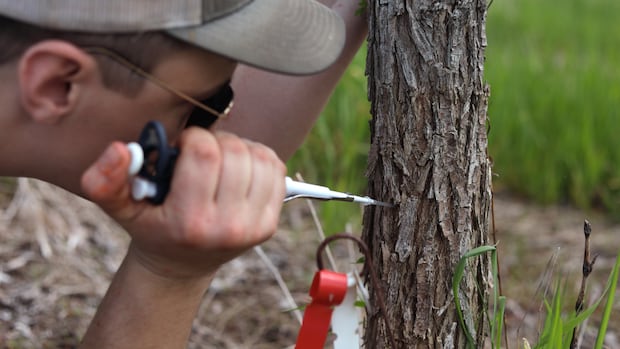
Scientists in the state of Vermont have spent the summer spreading Dutch elm disease to thousands of trees.
You read that correctly.
Researchers with the U.S. Forest Service and the Nature Conservancy want to see if a new generation of elms — bred from survivors of the disease — might have resistance to the fungus spread by bark beetles that has been decimating elm populations in the U.S. and Canada for decades.
The goal is one day repopulating areas where towering elms were once ubiquitous, lining city streets and thriving along river banks.
“The loss of the trees over the years has been devastating,” Gus Goodwin, a senior conservation planner for The Nature Conservancy, told The Associated Press.
Time will tell if the Vermont experiment will result in a strain of trees resistant to Dutch elm disease (DED). Researchers working on similar efforts here in Canada hope science will offer solutions at a time when the disease is becoming a threat in new areas.
“We’re not losing our elm population,” said Alison Morrison, a manager at the University of Guelph arboretum which operates the Elm Recovery Project. “What we’ve lost is our elms’ ability to grow old.”
WATCH | When Canada’s capital fell victim to Dutch elm disease (1979):

Ottawa’s elms are crashing down
In the shadow of Parliament Hill, stately elms fall victim to Dutch elm disease. » Read More
This story was brought to Nouzie by RSS. The original post can be found on https://www.cbc.ca/news/science/dutch-elm-disease-9.7329751?cmp=rss

