

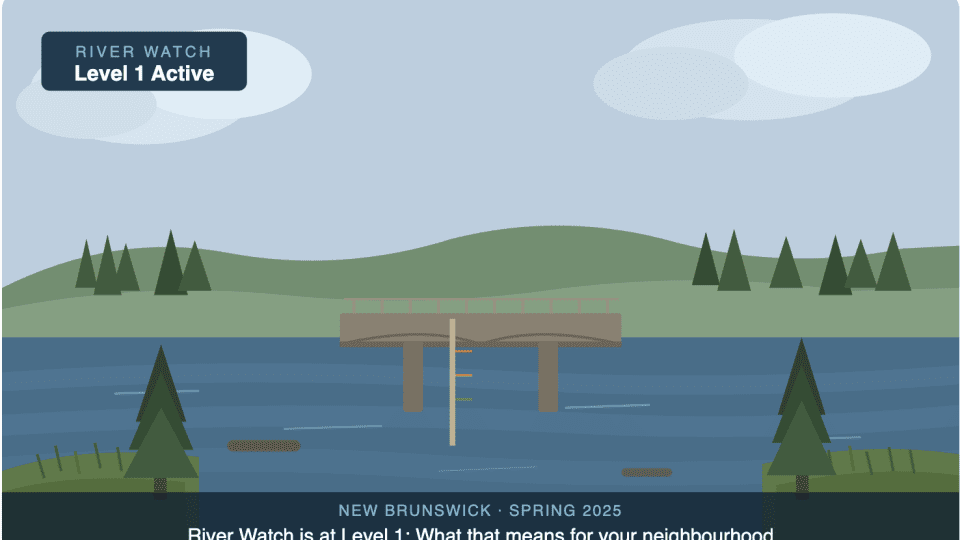
Spring in New Brunswick arrives with a certain restlessness. The snow recedes, the days stretch longer, and the Saint John River — the province’s great artery — begins to stir. For many New Brunswickers, this season comes with a familiar ritual: checking the River Watch system. If you’ve noticed the alert sitting at Level 1 right now, here’s what that actually means, and what you should be doing about it.
Understanding the River Watch System
New Brunswick’s River Watch program, managed by the provincial Department of Environment and Local Government, monitors river levels and flood risk across the province each spring. The system uses a four-level scale to communicate risk to residents and municipalities:
Level 1 – River Watch: Water levels are rising and being actively monitored. No flooding is expected at this time, but conditions are being watched closely.
Level 2 – Flood Watch: Flooding is possible. Residents in low-lying and flood-prone areas should begin preparing.
Level 3 – Flood Warning: Flooding is occurring or is imminent in specific areas.
Level 4 – Flood Emergency: A serious and widespread flooding event is underway, requiring emergency response.
Level 1 is the opening act — not an emergency, but a signal that the river is waking up and that the province is paying attention.
Why Spring Is Always the Anxious Season
New Brunswick’s flood risk peaks every spring for a predictable set of reasons. A winter’s worth of snowpack begins melting across the watershed, sometimes rapidly when warm temperatures and rain arrive together. The Saint John River drainage basin covers roughly 55,000 square kilometres spanning both New Brunswick and Maine, meaning that snowmelt upstream can raise water levels downstream days later, often with little warning.
When the ground is still frozen and can’t absorb meltwater, and when ice jams form on the river, conditions can escalate quickly. Communities along the lower Saint John River — Fredericton, Oromocto, Grand Bay-Westfield, and dozens of smaller riverside communities — know this rhythm well. The floods of 2018 and 2019 were among the most severe on record, serving as a stark reminder of how fast a Level 1 can become something much more serious.
What Level 1 Means for Your Neighbourhood Right Now
A Level 1 alert is not a reason to panic, but it is a reason to be ready. Think of it as the province saying: we’re watching, and you should be too.
Here’s what being at Level 1 practically means for residents:
If you live near the river or in a floodplain: Your home may be in a monitored zone. Check the River Watch interactive map on the New Brunswick government website to confirm whether your property falls within a watch area. Knowing now — before anything escalates — is far better than scrambling later.
Your basement and sump pump: Spring is always the time to make sure your sump pump is working. At Level 1, you have time to test it, clear debris from window wells, and make sure your drainage is directed away from your foundation.
Important documents and valuables: If flooding has ever affected your neighbourhood before, now is the time to move irreplaceable documents, photographs, and valuables to upper floors or waterproof containers. It costs nothing to do it early.
Know your exits: Flooding can happen quickly, particularly if an ice jam releases suddenly. Make sure every member of your household knows the plan — where to go, how to reach each other, and which routes out of the neighbourhood are on higher ground.
Check your insurance: Standard home insurance in New Brunswick does not cover overland flooding. If you don’t have a separate flood endorsement, it’s worth a call to your insurer. Unfortunately, coverage cannot be added once a watch or warning is already in place — another reason why Level 1 is actually a useful window of time.
Staying Informed
The River Watch system is only useful if you’re connected to it. The New Brunswick government provides daily updates during the spring watch season at gnb.ca, and many municipalities also share updates through their own social media channels and local emergency management offices. Environment and Climate Change Canada issues river ice and water level bulletins as well.
Sign up for Alert Ready notifications on your phone if you haven’t already. These are the same emergency alerts used for severe weather — they will push a notification directly to your device if conditions escalate to a higher level.
A Note on the Bigger Picture
New Brunswick has been grappling seriously with flood risk in recent years, and not only because of spring snowmelt. Climate patterns are making extreme precipitation events more frequent, and some communities have begun the difficult conversation about managed retreat from the highest-risk floodplains. The River Watch program has become more sophisticated, incorporating better modelling and earlier alerts as a result of hard lessons learned.
Level 1 is the system working as it should. The province is watching. Now is the time for residents to do the same — not with alarm, but with the quiet, practical readiness that anyone living beside one of Canada’s great rivers learns to carry into every spring.
For current River Watch updates, visit the Government of New Brunswick’s River Watch page at gnb.ca or follow your local municipality’s emergency management channels.

