


The province added more than 11,000 people last year. The fastest growth rate didn’t belong to Moncton, Fredericton or Saint John — it belonged to an island of fewer than a thousand residents.
For most of the last fifty years, the story of New Brunswick’s population was a slow leak: young people left, births fell, and rural communities emptied out one closed school at a time. That story ended around 2016. It hasn’t resumed.
As of July 1, 2025, the province was home to an estimated 869,680 people — up 11,389, or 1.3 per cent, in a single year. That’s a real slowdown from the 2.5 per cent surge the year before, but it was still the sixth-largest annual gain on record, and the eighth straight year of growth above half a per cent.
The interesting part isn’t the provincial total. It’s where the growth landed.
Campobello is a lesson in small numbers
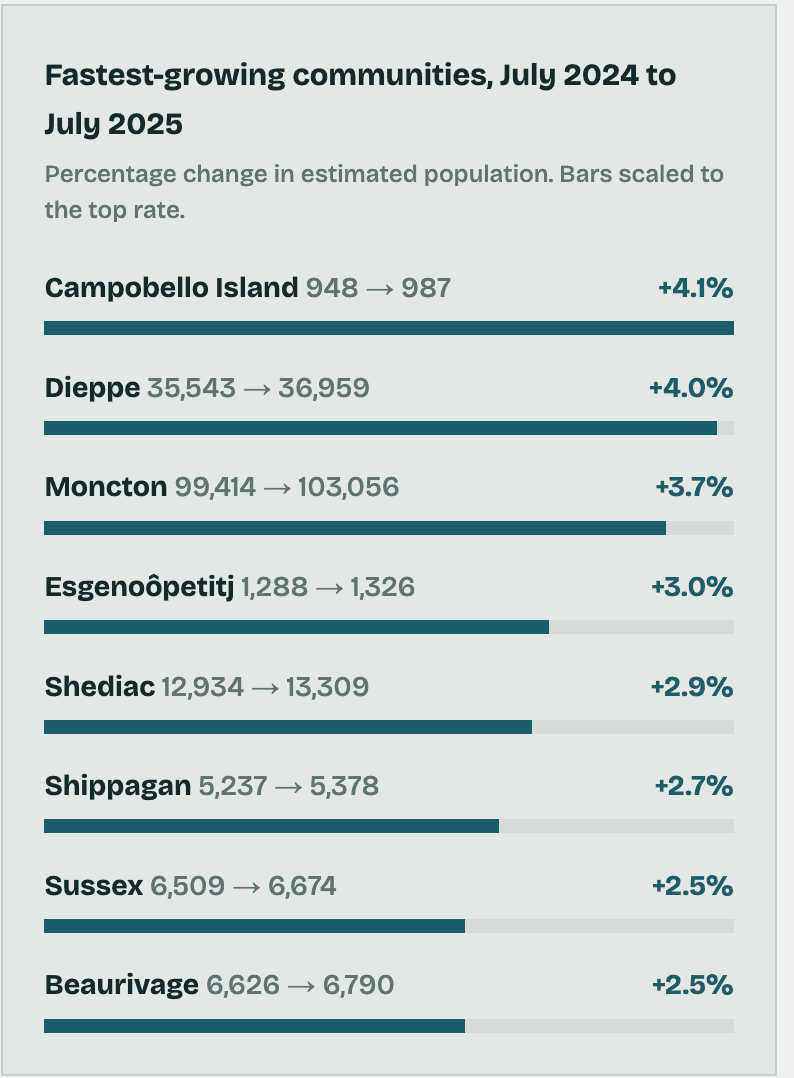
Campobello Island tops the list at 4.1 per cent — the highest rate in the province. It grew by thirty-nine people.
That’s the trap in any “fastest-growing” ranking. On a base of 948 residents, a couple of dozen new arrivals produces a headline percentage that a city of 100,000 could never match. Campobello, reachable by road only through Maine, is exactly the kind of place where a handful of retirees, remote workers or returning families reshapes the statistics. Treat the rate as a signal, not a trend. One year of it means very little; three or four in a row would mean something.
The same caution applies to Esgenoôpetitj (+38 people) and, to a lesser extent, Shippagan. The percentages are genuine. The populations behind them are small enough that a single apartment building or a closed group home can swing them.
Where the growth is actually durable
Strip out the volatility and a clearer pattern shows up: the strongest small-town growth in New Brunswick is happening within commuting distance of Moncton.
Shediac is the clearest example. It added 375 people in a year, and that growth is showing up in concrete. The town reported more than $111 million in building permit value for 2025 — including 152 residential permits and roughly $27 million in multi-family construction, plus a permit for a new English-language K–12 school. Multi-family construction is the tell. Towns that add apartments and condos are towns that expect to keep growing; towns that add only single detached homes are usually absorbing overflow from somewhere else.
Beaurivage, one of the amalgamated entities created in the 2023 local governance reform, sits in the same Kent-to-Moncton corridor and grew at the same 2.5 per cent clip. Sussex is the outlier in the top eight — not a Moncton suburb, but a service town on the Fundy side with a hospital, a highway interchange, and house prices that still look reasonable to someone selling in Ontario or the Maritimes’ larger centres.
The pattern is less “rural revival” than “the cities are spilling over, and the spill has to land somewhere.”
The other half of the ledger
Not everywhere gained. Over the same twelve months, the steepest declines were in Tobique (−3.9%), Upper Miramichi (−2.4%), the Acadian Peninsula rural district (−2.4%), Fredericton Junction (−2.3%), the Kent rural district (−1.6%) and Carleton North (−1.4%).
Geography explains most of it. The communities shrinking are the ones furthest from a hospital, a university or a highway to a city. Growth in New Brunswick is not spreading evenly across rural areas — it’s clustering along a few corridors and leaving the rest roughly where they were.
The regional picture
Zoom out to the twelve regional service commissions and the divide is stark, especially over five years:
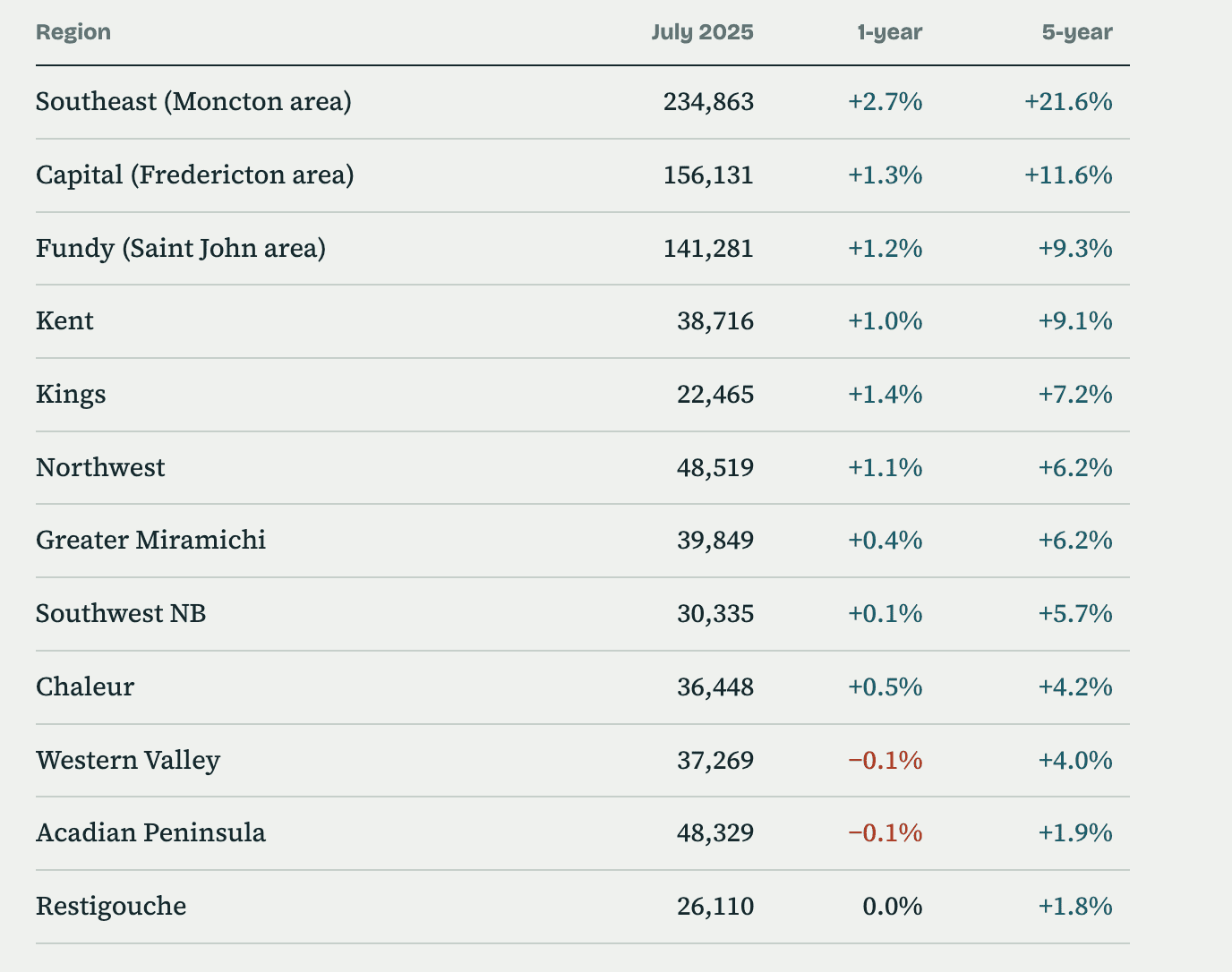
Greater Moncton grew by more than a fifth in five years. Restigouche grew by 452 people in total. Both are in the same province, and they are having completely different decades.
Read the numbers with two asterisks
First, these are estimates, not a census count. Statistics Canada builds them from tax filings, immigration records and health registrations. They’re the best sub-provincial data available between censuses, but they carry error, and the error is proportionally larger in small places. The 2026 census was taken this past May; results start arriving in February 2027, and some of these figures will move.
Second, New Brunswick’s 2023 local governance reform redrew most municipal boundaries. Places like Beaurivage and Carleton North didn’t exist in their current form before then, and towns like Shediac absorbed surrounding territory — which is why the Shediac figure here (13,309) is far larger than the 7,535 recorded in the 2021 census. Comparing a 2025 number to a pre-2023 one for the same named place will mislead you almost every time.
What happens next
Two of the three engines behind the boom are cooling. Net international migration fell to 14,975 in 2024–25 from 25,267 the year before, and federal cutbacks to immigration and temporary resident levels are expected to run until at least 2027. Interprovincial migration — the Ontario wave that drove much of the 2020–2023 surge — has flattened to roughly break-even as the housing price gap between the two provinces narrows.
That leaves natural change, which has been negative for eleven consecutive years. In 2024–25 the province recorded 6,618 births against 8,888 deaths.
So the near-term question isn’t whether growth slows. It already has. The question is whether the places on the list above can hold their gains once the tailwind drops off — and that likely comes down to housing. Shediac is building. Sussex has room. Campobello has an aging population and a bridge to Maine. Come February 2027, we’ll have a much better idea which of these was a trend and which was a rounding error.
Sources: Government of New Brunswick, New Brunswick Population Report (December 2025), drawing on Statistics Canada Annual Demographic Estimates for subprovincial areas as of July 1, 2025. Building permit figures from the Town of Shediac, February 2026. Census figures from Statistics Canada, 2021 Census of Population.

