


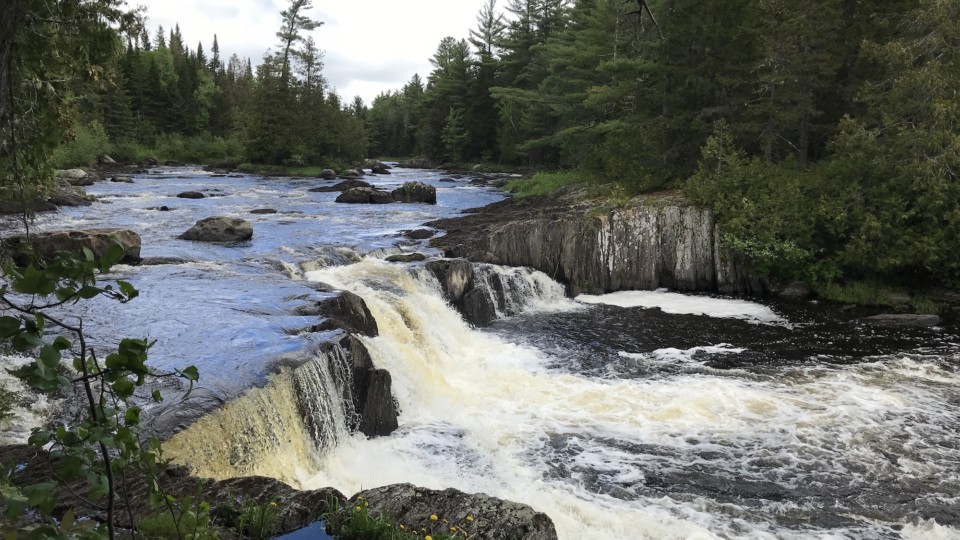
Waterfalls, mountains and beaches. When we’re near them, we feel good. At least I do – waterfalls especially. Watching water tumble over rocks and listening to the music it makes on its journey to the sea nourishes the spirit. Like currents of thought in the slipstream of time, history travels with it.
That’s what I was thinking last spring as I stood beside Eel River Falls after a short mountain bike ride from the village of Benton, one of my first adventures “out on the land” last spring. A bike ride along the old railway line into the falls as soon as the mud clears up will be an excellent launch to another summer of mountain biking.
It’s the negative ion molecules that give us positive vibes when we breathe deeply in certain environments. Once the negative ions reach our bloodstream, biochemical reactions increase serotonin levels, helping relieve stress and boost energy.
But it wasn’t just the negative ions giving me those pleasant feelings last spring. It was also the eons of human history that have unfolded at Eel River Falls and all along the Eel River and the rest of the ancient waterway known as the Maliseet Trail.
And it was my history with the Eel River, too, including sharing a campfire in June 1994 with two Maliseet friends, Patrick Polchies and Martin Paul, on the first night of their week-long journey along the ancient waterway to Old Town, Maine. Our friend, Dr. David Keenlyside, field archaeologist with the Museum of Civilization in Ottawa at the time, was also there.
With his depth of knowledge about the Indigenous people of Eastern North America, David, my canoe partner on that first day, was great to have along. Our task was to paddle down the river towards Patrick and Martin (the Eel flows into the St. John River at Meductic), who were paddling upriver and spend the first night with them. For the rest of the trip, they were on their own.
As we paddled, David explained that the Eel River and the rest of the Maliseet Trail played a significant role in the cultural development of the Maritimes and New England. For millennia, Indigenous peoples, including Wolastoqiyik (the Maliseet), travelled this ancient trail that connected Wolastoq (the St. John River) with the Penobscot River in Maine. When Caesar ruled Rome, Indigenous peoples were travelling this route.
In his book, Someone Before Us (Brunswick Press, 1968), the noted New Brunswick author, Dr. George Frederick Clarke, writes: “This system of waterways and relatively short portages, had been used from time immemorial both from and to the St. John River, but the Penobscot and Kennebec route was to become of vital importance in those stirring years when French and English struggled for mastery in the New World: a period when the Indian village, fort and portage at Medoctec became famous in the annals of both peoples.”
Experiencing the Maliseet Trail with people whose connection with the land goes back millennia was humbling. I recall how deeply moved Patrick and Martin were as they shared with us in the glow of the campfire how honoured they felt to trace the sacred steps and paddle strokes of their forbears.
As have others who have travelled the ancient trail over the centuries, my friends will discover footsteps worn into stone by the moccasins of their ancestors on their journey through time. When they make this discovery and others, they will honour their ancestors by offering tobacco and sweetgrass to attract good spirits and positive energy.
Good spirits and positive energy. That’s what I’m feeling now as I think about that long ago campfire beside the Eel River and my visit last spring to the falls that bears its name. I’m looking forward to seeing it again and watching water tumble over rocks. I’m also looking forward to listening quietly to the music it makes on its journey to the sea. Like currents of thought in the slipstream of time, history travels with it.

