


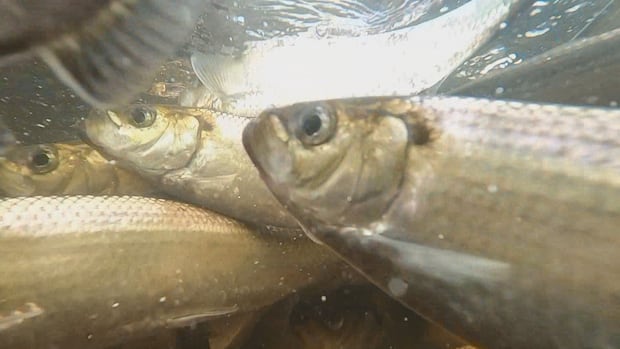
Every day in May and June, you can find Wayne Baker sitting by the banks of the Oromocto River in Fredericton Junction counting fish.
Not every fish. Just his favourite. In his hometown, he’s known as “the Gaspereau Man.”
“I’ve been fishing gaspereau here for over 70 years now, believe it or not,” Baker said. “And I’ve eaten a pile of them.”
The gaspereau population is smaller than it was when he was young, but follow the waters of the Oromocto out to the St. John River, and you’ll find a change that Baker believes is having a huge impact on the small fish.
Gaspereau is the collective term for two very similar fish species known as alewives and blueback herring. Gaspereau are what Baker and the Oromocto Watershed Association term a “keystone species,” bringing nutrients inland from the ocean and feeding local populations of plants and wildlife.
As they travel north to spawn, gaspereau are consumed by eagles, otters, bears and other species.
 Wayne Baker, known locally as ‘the Gaspereau Man,’ has been fishing for gaspereau for more than 70 years in his hometown of Fredericton Junction. (Shane Fowler/CBC News)
The gaspereau caught by commercial fishermen is mostly destined to become lobster bait. The fish itself contains a lot of small bones, making gaspereau it much less attractive for recreational fishing than species such as trout or bass.
Unless you’re Baker, who loves to brine them,
This story was brought to Nouzie by RSS. The original post can be found on https://www.cbc.ca/news/canada/new-brunswick/change-dfo-mactaquac-dam-sees-millions-of-more-fish-make-it-upriver-to-spawn-9.7199190?cmp=rss

