


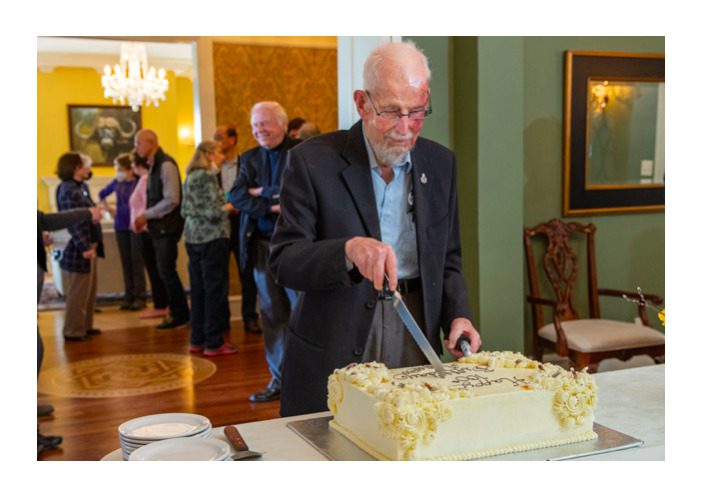
After spending a couple of hours discovering Angus’s remarkable accomplishments in a life overflowing with learning, adventure, harmony and love, I realize I’ve been given a considerable challenge. Looking over at Angus, I smile. With twinkling eyes and a mischievous grin, he looks at his old friend, John and then back at me. I get the sense he’s curious about what I find out.
Born in 1922, Angus was an only child. His mother and father, Annie (McClure) and Angus, imbued their son with a sense of responsibility, discipline and a fundamental respect for all living things. Although he had no brothers or sisters, family was important to him growing up. He loved getting together with his extended family on special occasions. “I liked the warmth of my mother’s family,” he recalls, “and I liked the adventurousness of my father’s family.”
The blending of the McClure and Hamilton families provided young Angus with a nurturing and loving environment, a solid foundation upon which he would imagine a future encompassing the best of both families.
“When I was quite young,” he writes in his latest memoir, My First Nineteen: 1922-1941 – Memories of Growing Up on an Ontario Livestock Farm During The Great Depression, “I daydreamed that I’d go around the world twice: once, when I was young, on the cheap, and once more later in life, in comfort; I also daydreamed that when I was elderly I’d have some expertise about which I would be consulted; and, of course, I envisioned a loving wife and family and I anticipated that I’d live into my eighties! In general terms I’ve achieved these objectives and in my last two decades I’ve published five books.”

My First Nineteen: 1922-1941 – Memories of Growing Up on an Ontario Livestock Farm During The Great Depression is available in Fredericton at Westminster Books. It’s also available on Amazon.ca
In 1939 Angus finished high school and soon after joined the Royal Canadian Air Force. The skills he learned as a radar technician during the war would be in high demand during the post-war boom, especially in a country as big as Canada. After returning home, Angus secured a position as a surveyor with Canada’s national mapping organization, further expanding his knowledge and experience. His work in Canada’s north, in some of the most hostile weather in the world, was particularly challenging.
At a post-game football party in Toronto in the late 1940s, Angus met Margaret Fisher, and in 1949 they were married. The couple lived in Toronto for two years, then moved to Ottawa, where they lived for the next 20 years.
In 1971, Angus and Margaret moved with their family from Ottawa to a property with a six-acre apple orchard they called Happy Apple Acres at the base of Currie Mountain, an extinct volcano near Fredericton. Angus was taking on the role of chair of UNB’s surveying engineering department. Over the next 14 years, he would assemble an academic team that would attract international acclaim.
During a recent UNB ceremony honouring Angus, John McLaughlin said, “Since its founding in 1960, the Department of Surveying Engineering (now the Department of Geodesy and Geomatics Engineering) recruited a group of world class scholars who provided the intellectual, professional and entrepreneurial drive, which set it on the path to becoming the best in the world.
“Over the next six decades,” he continued, “the Department went on to attract an amazing group of students, adjunct faculty, and research associates from across Canada and around the world who fundamentally changed the world of surveying and mapping, geomatics, and geodesy. Without question, the leadership crucial to building and sustaining this international legacy was provided by Angus Hamilton…. He was the conductor of a world class orchestra.”
Driving home from Angus’s through the February darkness, I thought about how inspired I felt listening to such enriching conversations over the last couple of hours. I also thought about his stories about surveying Canada’s far north and how it reminded him of when he was a boy trudging through snowdrifts in the freezing cold to get to the schoolhouse. What was it, I wondered, that gave him the ability to lead, inspire, and accomplish all he’d accomplished?
I would soon discover the answer in his latest book — his sixth — which Angus generously signed and gave me, My First Nineteen: 1922-1941 – Memories of Growing Up on an Ontario Livestock Farm During The Great Depression.
Reading Angus’s book and learning about the extraordinary challenges that stood in his way during the first 19 years of his life, including the death of his beloved mother when he was nine, I started thinking about Marcus Aurelius, the Roman emperor and Stoic philosopher, who observed that “What stands in the way becomes the way.”
For Angus, a man for whom geography, mapping and radar technology would play such a significant role in his career, discovering early in life that overcoming adversity would help him find ‘the way’ was an important lesson to learn.
When he needed to find the way during his war years as a radar mechanic with the RCAF or his various other careers, including working in the far north with the Geodetic Survey of Canada, how often did he think of the hundreds of life lessons he learned on the farm? Like the time when he wasn’t paying as close attention as he should and an old grey mare kicked him in the head. He still has the scar to prove it.
Despite Margaret’s passing in 2019, Happy Apple Acres remains a happy place, perfectly symbolizing her and Angus’s long and loving relationship and their love of family. The fragrance of apple blossoms continues to fill the air every spring, and the apples are always plentiful in the fall, a bounty that reflects the life of a dedicated and humble man who became, as his old friend John McLaughlin describes, the “conductor of a world class orchestra.”
If I were to choose a piece of music for that orchestra to play in honour of its conductor, it would be happy and encouraging, like the life of its conductor. Beethoven’s Sixth Symphony, the Pastoral, would do nicely.

