


“Every spirit builds itself a house,” Emerson wrote, “and beyond its house a world; and beyond its world, a heaven. Build, therefore, your own world.”
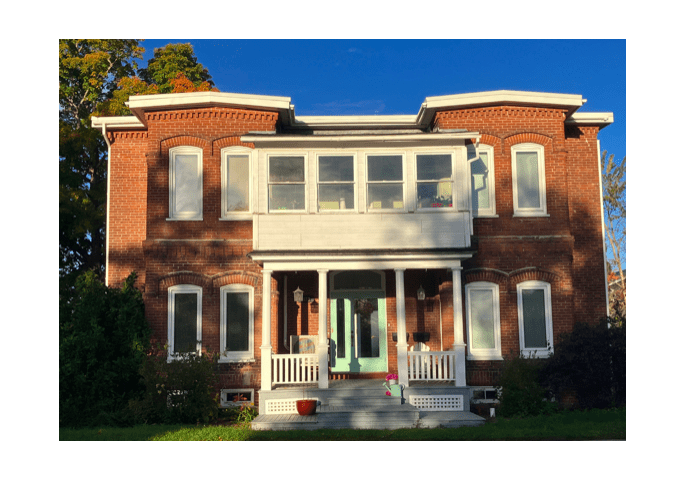
Every house has a story, a story about someone’s world, a story called home. As I write these words in the old brick house where I live in Marysville, I can’t help but wonder about all the human drama that’s unfolded inside these walls since it was built in the late 1800s — the births, the deaths and other great joys and tragedies.
Although it’s impossible to know all the stories, Roger Nason, historian and former archivist with the Provincial Archives of New Brunswick, says it is possible to discover some of them. It requires detective work doing what he calls a “genealogy of a property.” He’s found that, increasingly, more people are interested in researching their homes to discover who built them and when? Who lived there, and what happened to them?
One reason for the increased interest in documenting the history of individual homes and properties is that it builds value into what is often the homeowner’s most significant investment allowing them to preserve that history and pass it on to their children and grandchildren or future owners.
Another reason is that it’s easier than it used to be. “Digitized archives and other sources are more open to people and make it easier to do a broad search about people in places,” Nason says.
Recently, he traced the evolution of his son’s farm near Keswick Ridge and its holdings from the Loyalist period up to the present day to see exactly who occupied that space. He had a hunch about the individuals and families living there in the late 19th century and early 20th, but he didn’t know about them before 1870 or after 1930.
“I didn’t have a complete picture of the role played by the people in the space. Nor did I have an appreciation of how that space had changed over time. In this case, being farmland, it started out as a Loyalist grant, which was over 200 acres. By the time I was done, I was down to eight acres to bring it to the present day.”
Looking through that span of time, Nason says, no matter whether it’s a new house on a property or a heritage home on a property, you have to look at both the surrounding environment and the home to appreciate the people and what they experienced. “You might use land registry records, or you might use vital statistics, family records, or even some personal collections that are now available digitally.”
Online newspaper archives are among the best sources because they allow researchers to reach back into the 19th century to find information that puts meat on the bones. Back in the day, newspaper editors often included stories about who was building a new home or renovating an existing one. Newspapers give you a chance to put a whole new dimension on the history of the property or the individuals who lived there and their interaction with other people.
“It’s one thing to have a census record of somebody in 1911 and know the members of the family that were living there,” Nason says, “but it’s another thing to know what they experienced. What did they go through? And how did that relate to the space they were living in? Did they hold weddings or even funerals there? Buildings have a narrative to tell.”
As I think about Nason’s words, in my imagination, I hear newborn babies crying and the sobbing of someone who’s lost a loved one to war or the Spanish Flu epidemic of 1918. Looking out the window, I see children climbing the big sugar maple in the backyard and a farmer hitching up his team to take the fruits of his labours to the Phoenix Square market in downtown Fredericton.
Every house does have a story, I think, as I contemplate what the grounds around this stately old house beside the Nashwaak River once looked like. It’s a story about someone’s world, a story called home.

