


On May 6th a surprisingly large audience attended a presentation at UNB entitled, “Gravity: Recognizing 100 Years of Einstein’s Relativity”. The speaker was Dr. Sanjeev Seahra of UNB whose presentation was followed by a panel comprising: Ms. Masooma Ali, PhD Candidate, UNB; Dr. Jonathan Ziprick, UNB; Dr. Hari Kunduri, Memorial University; and Dr. Steve Turner, UNB.
While predictions following from relativity have been confirmed to an extraordinary degree of precision, to date relativity and the other great revolution in physics, quantum mechanics, have yet to be reconciled. In fact, Einstein was himself of the view that the world was not as unbound from deterministic cause and effect as quantum mechanics asserts. The irony, as Dr. Seahra pointed out, was that if one arrayed the great physicists of the 20th century in terms of the split between the relativists and the quantum mechanists, the work Einstein did (on the photoelectric effect) that won him a Nobel prize, places him among the quantum physicists.
Following the presentation the panelists took turns commenting on Einstein and relativity and then answered challenging questions from the audience. It was quite apparent that, as those who follow contemporary physics know, matters are far from settled and the discussion contained a lot of “estimates”, “opinions”, “probably” and similar words indicating the deep issues unresolved by either of these major theories. The nature of dark matter and dark energy, superstrings, M-theory, the possibility of multiple universes and dimensions and the like, point to what Lee Smolin of the Perimeter Institute at Waterloo refers to as the trouble with physics. But these great uncertainties serve to motivate rather than deter the search for answers, as was evident in the enthusiasm of the presenters and the audience.
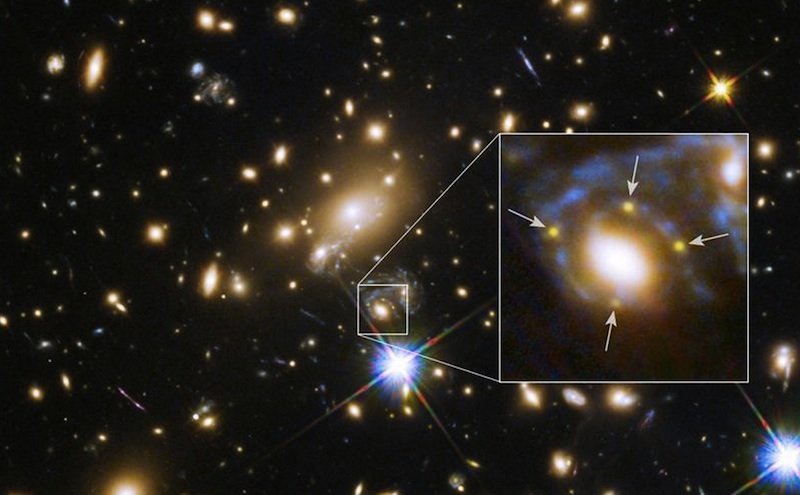
[Main image: NASA, taken by Hubble]

