


Introduction
The recent storm brought home to many of us the inter-dependence of technical, moral, and political issues. Our world changed dramatically in a matter of hours as many of us lost electric power for several days. How were we to get by individually and collectively? The technical issues could be as simple as access to a generator to temporarily maintain a water supply and refrigeration.
The moral issue consisted of questions as to how our public or collective resources were being distributed in the effort to restore power and get things back to “normal”.1 This latter moral issue is a much thicker and stickier problem that also needs to be confronted and it cannot be avoided by becoming immersed and even lost in the technical issues as important as they may be.
Also, there is the fact and relevance of the current federal election. But I worry greatly that the temptation to engage in self-serving political theatre during election campaigns can obscure the real issues and our capacity for bringing intelligence to bear on these matters.
Therefore this following reflection is a very summary gloss on the philosopher Alasdair MacIntyre’s insights into the moral nature of this problem and how the ancient Greek thinker Aristotle and the tradition he inspired may be able to assist us in sorting things out.
Appealing to Aristotle and the best in the philosophical tradition he represents, I believe, can assist us in approaching the issue in a more satisfactory and effective manner. However, as both the ancient Aristotle and the more contemporary MacIntyre would insist, this realistically will take the virtues of patience and courage, along with some moral intelligence both individually and collectively.2
Fairness and Community
The basis of any community or body politic has to be some sense of justice or fairness. Without this sense of fairness, we lack the basis for effective governance which involves both planning and execution as central elements.
In simple terms we can say that moral virtue is the disposition to obey certain rules and so agreement on the relevant rules is the pre-condition for agreement as to the nature of virtue.
The critical issue for us in our very fragmented and individualistic culture is that the prior agreement on the required rules is increasingly difficult to achieve.
The Aristotelian tradition has always viewed virtue as those human qualities that enable us to achieve those goods important for the good life for the human being and vice as the lack of those virtues which prevents the realization of these human goods.
However, we now are encountering moral and political controversy that seems immune to rational resolution. What now follows is an effort to illustrate the deep philosophical dimension of this situation.
I set up an outline of a debate between two fictitious characters named Irvine and Robichaud. The allusions to the more familiar New Brunswick names of Irving, our biggest home grown corporation, and Louis Robichaud, perhaps our most adventuresome Premier of the recent past, and so also allusions to the days and controversies of Equal Opportunity, is intentional.
The Argument and Its Implications
Irvine has great wealth for the purpose of providing his family and friends with the means to the good life. Any claim upon this wealth and his ownership of it is unjust so he sees government’s role as essentially that of defending his property rights.
Robichaud by contrast sees an arbitrariness in social inequality, and so inequality in wealth and opportunity needs justification. Somehow it must serve the greater functioning of society while also benefiting the poor and disadvantaged in some way. Thus Robichaud supports redistributive taxes and wants a government that is committed to this principle.
We have here a conflict in respective claims – between the claim of justified entitlement and that of justified need. There is what is called an incommensurability in these rival claims that under the present philosophical climate is irresolvable. Nonetheless there are elements of this debate that are vestiges of an older moral tradition.
Reflecting on these two aspects of the present moral conflict reveals the presuppositions of these two sides of the debate – a principle of equality with respect to entitlement and a principle of equality with respect to social needs.
For Robichaud it is irrelevant how one comes to be in grave need, for justice is only about present day distribution patterns whereas for Irvine evidence of legitimacy in acquired past wealth is relevant to the notion of justice.
How are these two conflicting positions to be resolved?
What is crucial to recognize is that neither account attends to the issue of how, in the first place, a person is deserving in these conflicting accounts of justice. It is this element of being justly deserving that makes each party to the debate feel so strongly about their own positions.
In both Irvine’s and Robichaud’s positions, worthiness has little or no place in their respective discussions of justice. For both Irvine and Robichaud, our society is solely composed of individuals each with his/her own interests who in coming together have to formulate some common rules for their life together in a society.
For Irvine there is the primacy of the negative rule of non-interference in one’s pursuit of one’s interests and for Robichaud there is the rule that a prudent self-interested rationality would impose in circumstances of inequality.
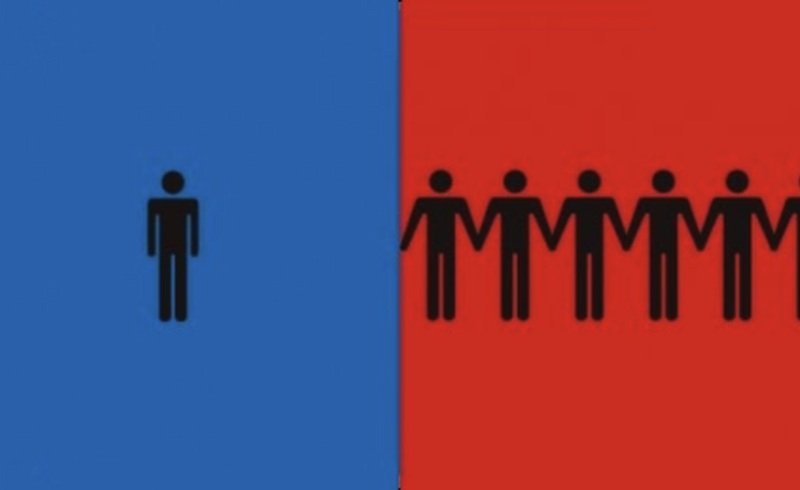
In each case individuals are primary and the society or community is secondary. The identification of individual interests is prior to and independent of the development of any social and moral bonds between individuals.
Commentary
The notion of being rightfully deserving, according to the older Aristotelian tradition we’ve alluded to, is meaningful only in a community context. A context where the primary bond is a shared understanding of the good for the human person and his/her community and where individuals identify their primary interests in reference to these goods.
This is quite different from the radical individualist and instrumentalist views of our day that understand our social life as secondary and as entered into voluntarily by a potentially rational individual with prior interests, who is subsequently asked to work out some social contract with others in a reasonable manner. This is a view that simply is empty of any understanding of real community.
Irvine’s account serves an ideology or mythology about the past that is highly selective and is governed by the claim that all legitimate entitlements are traceable to legitimate acts of original acquisition. Robichaud’s account is based upon a strategic self-interested pragmatism concerned with the efficient functioning of a society also composed of individuals each pursuing their own interests.
Conclusion
Any appeal to being rightfully deserving and worthy by either Irvine or Robichaud would expose the serious limitations of their respective positions and reveal the implicit and unconscious roots in an older Aristotelian and even Christian view of justice.
My firm conclusion is that such an appeal is now necessary accompanied by an honest and intelligent assessment of these important intellectual and moral roots.
It is necessary to reason intelligently on this matter so as not to unwittingly and regrettably fall back on the pre-dominant use of coercive and manipulative power as we try to prepare ourselves individually and collectively for what is to come.
1 For the purposes of this short essay, I’m setting aside the disturbing issue of climate change and its ethical and political implications and focusing only on the issues directly related to individual and community preparedness.
2 Alasdair MacIntyre’s After Virtue (Notre Dame: University of Notre Dame Press, 2008) may very well be one of the most important and prescient works in moral philosophy written in modern times. This reflection is a gloss on sections of this work, see especially pp. 244-255.
[Image source: www.ideapod.com/idea/The-Rise-of-Individualism-or-Collectivism/54156c14776562043aa90500]

