


I have not been listening to the news for some time. This period of “fasting from the news” has made me much more sensitive to what makes sense and what doesn’t, and perhaps more importantly to how news reports manipulate my emotional responses to events in usually disagreeable ways.
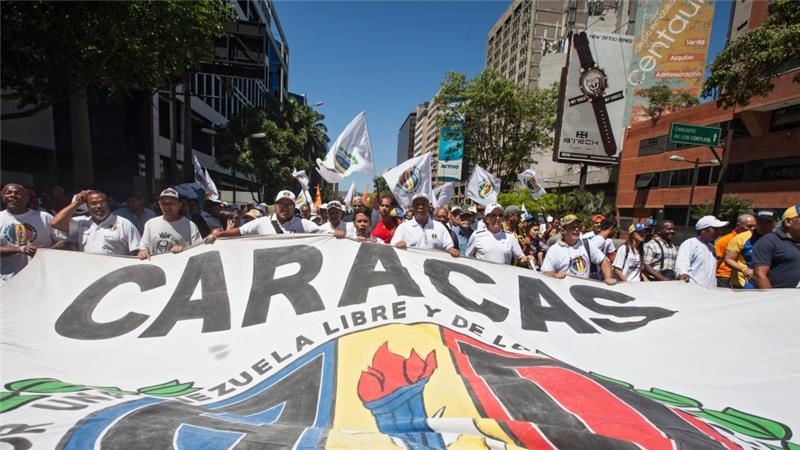
I listened to the news last evening and heard of the trouble in Venezuela on the CBC. Food shortages, soaring inflation, long queues for basic goods, increasing conflict and violence. Venezuela is not that far from New Brunswick. Recently things were said to be going well there and a progressive government was trying to implement reform. What then has gone wrong?
The answer explicitly and implicitly given in the CBC report was that socialist policies had devastated the economy. Though there may have been some truth in these brief remarks, I felt I was being manipulated by the media, our media, even the CBC.
I went searching for another analysis and this is what I found.
There is a type of summary analysis among progressive and leftwing thinkers in Latin America that goes something like this:
Rightwing regimes and neo-liberalism destroy the middle class; the impoverished middle class vote for a progressive or left wing government; this government improves the standard of living of the middle class; the middle class come to believe their interests are more in line with those of the oligarchy and so they end up voting for a rightwing regime.
This is a sad and discouraging logic of sorts, especially for those with progressive commitments. Yet it does shed a different and important light on developments in Venezuela especially after the defeat of the socialists in the recent general election. One voter summed up things this way – “I used to be really poor. And thanks to Chavez I’m not anymore. But now that I’m not poor any more, I vote for the opposition.”
Is it inevitable that leftwing and progressive governments that improve the standard of living will lose significant support among those who benefit most from their policies? Not necessarily, because it is believed that there are different ways to improve the standard of living.
When the approach is mainly one of boosting consumption, people become subject to market forces. Getting your children into private schools, accessing private healthcare, and creating pensions through investments does not develop the political consciousness seen to be needed.
Developing public services is regarded as a more effective way of developing the needed political consciousness. However this means raising taxes, and taking on the owners of businesses which involves entering into increasing zones of conflict which is contrary to any political strategy of reform based upon conciliation and compromise among diverse interests.
In addition, Venezuelan’s progressive governments have not been able to move away from dependency on exports of primary goods and so have remained vulnerable to international price fluctuations. Neither has tax reform been very successful because as the economic cycle enters phases of slow down, income decreases and the monies available for redistribution disappear. This creates the conditions for increased social conflict.
Helping the economically weak then antagonizes the economically strong. When a government infringes on the interests of the economically strong it needs the support of the economically weak.
This, it is believed, points to the importance of developing social movements capable of pitting a realistic and effective hope against what now appears to be very depressing economic, political and social circumstances.
The question asked now is – is this really possible?
And nearest I can tell, the answer is that “it is now necessary.”
(Based upon insightful articles by Gregory Wilpert, “Venezuela lurches right” and Renaud Lambert, “After the Latin Revolution” (Le Monde Diplomatique, January, 2016))
[Feature image via Aljazeera.com, embedded image from Associated Press via CBC.ca]
Hugh Williams
June 22, 2016

