


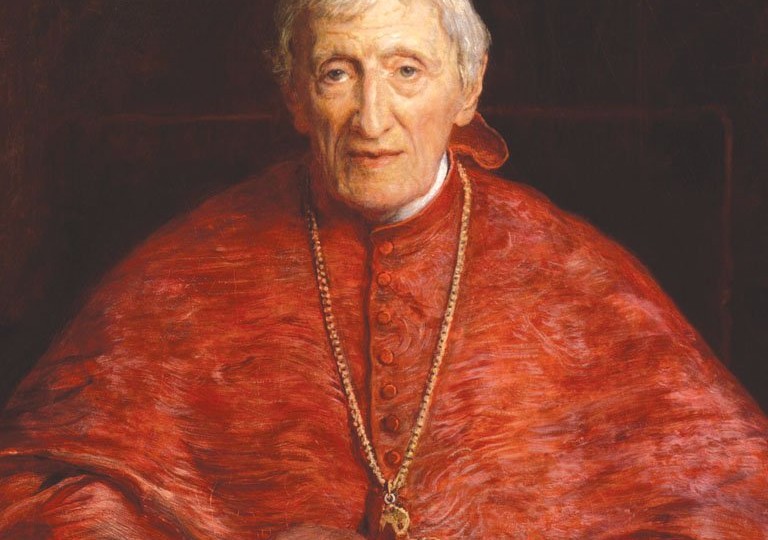
1) According to Alasdair MacIntyre’s insightful retelling [1], it was the recently canonized Cardinal Newman with his rich philosophical perspective who provided the much-needed antidote for the defensive tendency in 19th century Catholic thought. For Newman, all human beings always have some form of faith and have beliefs based upon this faith that go beyond the evidence of natural reason. So for Newman revealed theology clearly has its place in the Catholic university as it is needed to correct the distortion and corruption to which natural reason left to itself was prone. Thus all understanding ultimately had a theological aspect.
2) Philosophy for Newman involved a wholistic grasp of the universe through an effort to understand its parts. This meant there was a vision of the university as a whole having a purpose embodied most comprehensively in theology and philosophy. However, there was a tendency of the other sciences to trespass into the intellectual territory of philosophy and theology for which they were ill equipped, and for these sciences to make claims they couldn’t justify because of the limitations of their methodology.
3) The aim of the university for Newman was never reducible to career preparation but rather to develop the human being so that one can engage in enquiry, discussion, and debate and exercise proper judgment in the complex and difficult situations of practical life. These were intellectual virtues and for Newman these needed to be distinguished from the moral virtues. [2]
4) Newman believed universities tended to confuse these two sets of virtues often acting as if the cultivation of an aesthetic distaste for bad behavior was the same as good moral sense. Newman was convinced that this important distinction was clearly evident in the moral teachings of the Catholic Church.
5) In Newman’s view the university had serious limitations in regards to moral education and furthermore tended to deceive itself regarding the nature of this limitation. He saw moral philosophy as a particular aide in this self-deception. For Newman assent to various moral propositions is not the result of a demonstrative argument, instead our move from reason to assent was an exercise of judgment that can only be described as a phronesis (practical wisdom) of conscience.
6) There were three major differences between the aesthetic and moral sensibility in Newman’s view: 1) the aesthetic sense was concerned with a whole range of objects without discriminating the profound difference between the human person and these other objects, 2) aesthetic taste provided its own evidence appealing to a sense of the beautiful and the ugly, whereas 3) the moral conscience reaches out towards and desires to conform with some commanding or constraining sanction addressed to us by some unique and incomparable higher power beyond one’s self. Sorting out this difference between aesthetic taste and moral conscience is important for two reasons, 1) acknowledging the importance for this distinction can be a guard against the self-deception that can result from even the best university education, 2) by acknowledging this difference we place ourselves on the threshold of an awareness of God.
7) Arguments outside of pure mathematics and logic tend not to have the same compelling force and to remain more probable rather than demonstrative. For Newman it is our backgrounds, our existing thoughts, beliefs, principles, hopes, and desires all integral to our self-identity and self-understanding that so greatly influence our assent or dissent to reasoned argument. Thus our response to an argument is said to be as much a test of us as it is of the presenting argument. Thus according to Newman, one’s character plays a role in one’s openness to the truth and this in turn will inevitably determine one’s philosophical stance. [3]
8) What then are these arguments that direct us towards the truth? For Newman these were arguments that integrated a theological understanding of the created universe with the understanding provided by the various secular disciplines. According to Macintyre, Newman succeeded in defining the tasks confronting Catholic thought in a general way without identifying the philosophical resources for carrying out these tasks. However, a major problem was that Catholics had forgotten much of this tradition and so it was to this problem that Pope Leo XIII directed his attention in his great encyclical Aeterni Patris.
_________
- See Alasdair MacIntyre’s, God, Philosophy, Universities: A Selective History of the Catholic Philosophical Tradition (Toronto: Rowan and Littlefield Publishers, 2009), see especially pp.147-150.
- For Aristotle the intellectual virtues assisted one in the pursuit of the truth as theory, in the sense of seeing things with one’s mind as these are meant to be seen. These virtues were – understanding, science, wisdom, and prudence; whereas the moral virtues – prudence, justice, temperance, and fortitude, assisted one in acting intelligently in the pursuit of the good life that is, living life as it was meant to be lived by a human being. The process of achieving human well-being or happiness as the goal of a human life, required phronesis – practical wisdom, and involved the development of both intellectual and moral virtues. It seems that prudence provided the conceptual and practical bridge between these two orders of virtue.
- This insightful discussion by MacIntyre of Cardinal Newman’s crucial role in developing and promoting an understanding of Catholic higher education perhaps can better help us to see why so many of the Bishops and Popes have always attributed such cultural importance to Catholic higher education. More specifically Newman helps us see why it is argued that the tradition properly presented and communicated can be important not only in the intellectual development of the human person but in his/her moral development as well.

