


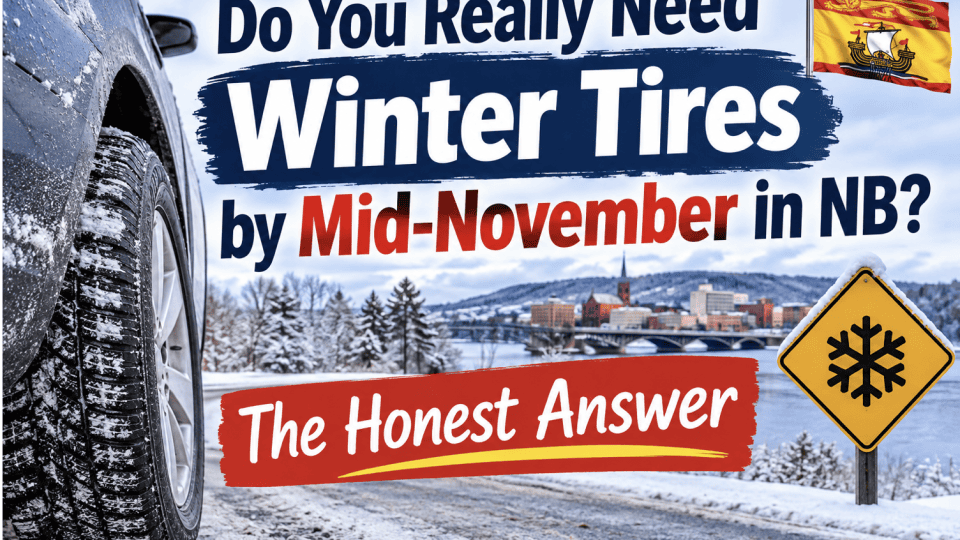
Every fall, the same debate plays out in New Brunswick driveways, garages and Facebook groups: is it really time for winter tires, or can I squeeze a few more weeks out of my all-seasons? The short answer is that mid-November is a smart target. But the honest answer is a bit more interesting than a date on the calendar.
First, the legal question
Unlike Quebec, where winter tires are mandatory from December 1 to March 15, New Brunswick has no law requiring them. So nobody is going to pull you over on November 15 for running all-seasons. If you cross into Quebec for a weekend trip, though, their rules apply to you, so plan around that.
But “legal” and “smart” are two different things, and that gap is where the real decision lives.
It’s about temperature, not snow
The biggest myth about winter tires is that they’re for snow. They’re really for cold. Rubber in all-season tires starts to stiffen once temperatures drop below roughly 7°C, and that stiffness means less grip, longer stopping distances and slower reactions on dry pavement, not just on snow and ice. Winter tire compounds stay soft and pliable in the cold, which is why they grip better even on a bare, cold road.
Think about a typical New Brunswick November. Mornings regularly sit near or below freezing, and daytime highs hover in the single digits. Black ice shows up long before the first real snowfall, often on bridges, shaded stretches and the Saint John River valley’s early-morning commutes. By mid-November you’re already living in winter tire weather, whether or not it has snowed.
Why mid-November works as a deadline
A useful rule of thumb: when the daily average temperature is consistently hovering around 7°C or colder, it’s time. In most of the province that happens in late October or early November, so mid-November is really the latest comfortable date, not an early one.
There’s also a practical reason. Tire shops get slammed the first time snow is in the forecast. If you wait for the storm, you’ll wait in line, sometimes for days. Booking your swap in early November means you choose your appointment instead of scrambling for one.
Who can safely wait a little longer?
Being honest, not everyone needs to rush:
- Low-mileage, short-trip drivers who mostly stay in town and can stay home during bad weather have more flexibility.
- Drivers with a mild, dry stretch in the forecast might push a week or two, as long as they watch overnight lows.
And who shouldn’t wait?
- Anyone commuting early in the morning or on highways, where cold pavement and black ice catch people out.
- Rural drivers on less-plowed secondary roads.
- Anyone towing, hauling kids, or driving a heavy vehicle, where longer stopping distances matter even more.
“But I have all-wheel drive”
AWD helps you get going. It does nothing to help you stop or turn. Your brakes and steering depend entirely on your tires’ grip, and that’s where winter tires earn their keep. An AWD vehicle on all-seasons in the cold can accelerate confidently right up to the point where it can’t stop.
What about the cost?
Winter tires are an upfront expense, but you’re not really paying double. You’re splitting the wear between two sets, so each lasts longer. Many drivers also find that a dedicated set on its own rims makes the seasonal swap quicker and cheaper. It’s also worth asking your insurer whether they offer a discount for winter tires, since some do.
The honest bottom line
You don’t legally need winter tires by mid-November in New Brunswick. But if you drive regularly, you almost certainly should have them on by then, and for many people, earlier is better. The calendar is a decent reminder, but the thermometer is the real boss. When the mornings are consistently near freezing, your all-seasons are already working outside their comfort zone.
Book the appointment now, check your tread depth, and get it done before the first storm turns it into a scramble. Your future self, stopping calmly at a slick intersection, will thank you.

