


July 20, 2026
Here’s a quick three-question quiz for you:
1. What percentage of Canada’s GDP comes directly from the oil & gas industry?
a) Less than 10%
b) 10-20%
c) 21-30%
d) 31-50%
e) Greater than 50%
2. What’s the percentage when you also factor in indirect contributions (IE downstream industries and jobs)?
a) Less than 10%
b) 10-20%
c) 21-30%
d) 31-50%
e) Greater than 50%
3. What percentage of employment in Canada comes directly and indirectly from the oil & gas industry?
a) Less than 10%
b) 10-20%
c) 21-30%
d) 31-50%
e) Greater than 50%
Answers are below, but before you look, consider:
- The bulk of the Canadian oilpatch – 59 per cent – is actually not Canadian at all; it’s owned by American investors and funds. That means most of the profits and dividends end up south of the border too.
- It’s estimated that the world’s top 100 oil and gas companies pocketed more than $30 million in extra profits every hour in the first month of the US-Israeli war in Iran – this as consumers around the world were left paying record prices for gas that didn’t actually cost a penny more to produce.
- According to a new analysis by Environmental Defence Canada, our federal government provided $10.2 billion in direct subsidies and public financing to the oil and gas industry in 2025.
- The fossil fuel industry continues to lobby heavily in Ottawa, meeting with federal officials nearly 1000 times in 2025. InfluenceMap concludes that lobbying is one of the major reasons why Canada’s climate policies have been systematically weakened by the Carney government since taking office.
- About 40 percent of global shipping emissions are caused by the shipping of… oil, gas and coal. In other words, eliminating our need for those fossil fuels would simultaneously eliminate nearly half of global shipping emissions.
- The fossil fuel industry knew as early as 1977 that emissions from the burning of oil, coal and natural gas would cause climate change, but refused to acknowledge that reality publicly, and has even funded misinformation to delay climate action.
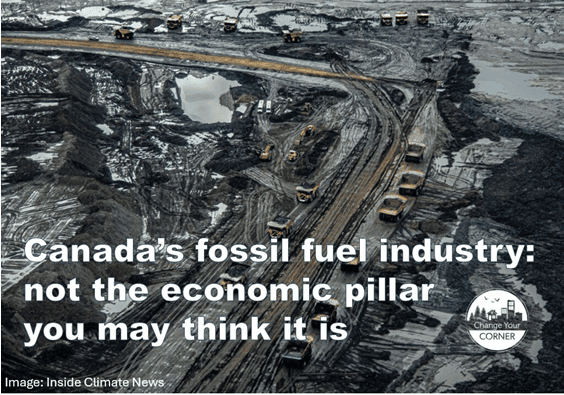
- There are now over 300 square kilometers of toxic tailings ponds in the Alberta oil sands, equal to twice the area of Grand Lake, New Brunswick’s largest lake. Virtually zero reclamation has taken place to date, and the Alberta and federal governments budgeted $58 million last year for monitoring activities.
- There are about 500,000 oil and gas wells in Alberta, the center of Canada’s oil and gas industry. About 170,000 of them are abandoned, and several thousand of those have been orphaned: left behind when the companies that owned them went bankrupt. That’s left a cleanup bill of over a billion dollars (covered in theory by an industry fund that is likely far too small for the task) in addition to hundreds of millions in unpaid municipal taxes and tens of millions in unpaid lease fees to farmers and other landowners. And it’s left Alberta taxpayers largely on the hook.
And the answers to the quiz? From pages 9 and 102 of Natural Resources Canada’s Energy Factbook 2024-25:
1. What percentage of Canada’s GDP comes directly from the oil & gas industry?
a) Less than 10% – actually 6.1%
2. What’s the percentage when you also factor in indirect contributions (IE downstream industries and jobs)?
a) Less than 10% – actually 7.7%
3. What percentage of employment in Canada comes directly and indirectly from the oil & gas industry?
a) Less than 10% – actually 2.9%

Thanks to clever marketing and a big public relations budget, the oil and gas industry has convinced many Canadians (including many elected officials) that it is indispensable to our prosperity. Hopefully the above numbers and realities help demonstrate that it’s not the economic pillar it would have us believe it is; and it has many skeletons in its closet.
Posted by carlsgreenideas
Filed in Uncategorized ·Tags: Alberta, canada, climate, climate change, economy, emissions, employment, energy, environment, fossil fuel, gas, GDP, oil, oilsands, subsidies, sustainability, tailings ponds
This story was brought to Nouzie by RSS. The original post can be found on https://carlsgreenideas.wordpress.com/2026/07/20/less-known-truths-about-canadas-oil-and-gas-industry/

