



Walk into almost any chamber of commerce meeting in Fredericton, Moncton, or Saint John these days and you’ll hear a version of the same conversation: someone has a great idea, they’ve done the homework, they’re ready to hire — and then they hit a wall. It might be a permit that takes six months. It might be a skilled worker they can’t find, let alone afford to recruit from out of province. It might be a grant program that looks perfect on the government’s website but turns out to be paused, oversubscribed, or designed for a company twice their size. The wall has many faces. But the wall keeps showing up.
New Brunswick’s government has spent the better part of a decade branding itself as a province that welcomes entrepreneurs, courts investment, and is actively dismantling barriers to growth. The slogans shift with each administration, but the message stays consistent: we’re open. We’re ready. Come build here.
Local entrepreneurs, increasingly, are not so sure.
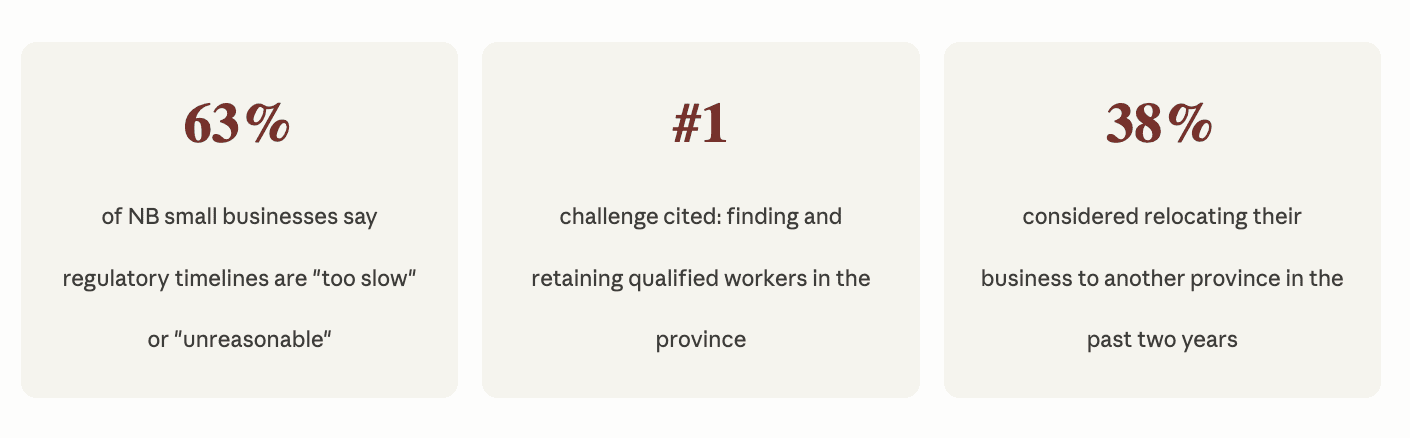
What the government says vs. what founders experience
There is a genuine perception gap between how provincial economic development is described in policy documents and how it lands on the ground. To be fair, New Brunswick has made real progress in some areas — immigration pathways that funnel skilled newcomers to rural communities, investments in broadband infrastructure, and a startup ecosystem in Fredericton that has produced legitimate success stories. Opportunities NB and various regional development agencies have green-lit projects that might have stalled elsewhere.
But success stories tend to cluster. They tend to involve companies already working in sectors the province has identified as strategic — tech, life sciences, agri-food. If your business doesn’t fit neatly into one of those lanes, or if you’re operating in a mid-sized town that isn’t Moncton or Fredericton, the support network thins out quickly.

Regulation isn’t the enemy — but its execution often is
No serious entrepreneur argues for a regulatory free-for-all. Environmental protections, labour standards, and building codes exist for good reasons. The frustration isn’t with regulation itself — it’s with the execution. Inconsistent advice from different government offices. Approval processes that don’t communicate with each other. Municipal zoning rules that haven’t caught up with how people actually work and build businesses in 2026. A permit that requires an engineer’s stamp for something that would be approved by inspection two provinces over.
The cumulative cost of this friction is hard to quantify but very easy to feel. It’s the lawyer’s bill you didn’t expect. It’s the three months you spent on paperwork instead of customers. It’s the investor who asked a question about your licensing timeline and didn’t call back.
Growth without people to do the work
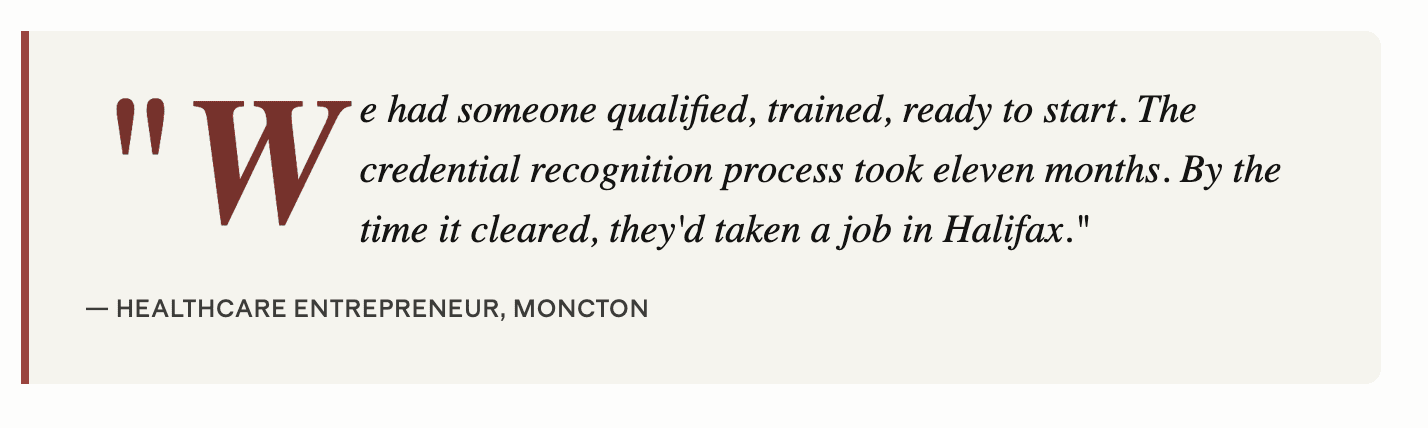
If red tape is the first complaint, workforce is the close second — and increasingly, the more existential one. New Brunswick’s demographics are improving relative to where they were fifteen years ago, largely because of immigration. But the pipeline is unpredictable, credential recognition remains a bureaucratic maze for many newcomers, and the housing market in desirable urban centres has tightened enough to make recruitment harder than it was even three years ago.
Small businesses compete for labour against the public sector, against national chains with structured HR departments, and against remote-work employers in Toronto or Boston who can offer wages New Brunswick operators simply can’t match. The province can’t fix wage disparity by decree. But it could do more to reduce the friction around training, apprenticeships, and the recognition of international experience.
Entrepreneurs aren’t asking for much — just consistency
The entrepreneurs who spoke for this piece weren’t looking for bailouts or sweeping policy revolutions. The ask, repeated in almost every conversation, was simpler: consistency. A single point of contact that actually knows the answer. Predictable timelines. Honest communication about what programs exist and what they don’t cover. Government economic development staff who have spent time in the private sector and understand that time is money in a way that can’t always wait for the next budget cycle.
There are models to draw from. Other small provinces and states have experimented with red-tape reduction offices that have real teeth — not just advisory roles but authority to flag and fix bottlenecks. Some have created fast-track licensing pathways for new businesses in their first two years. None of this is radical. Most of it is just operational improvement.
New Brunswick has real advantages that get undersold: low cost of living relative to central Canada, a bilingual workforce, geography that works for Atlantic trade, and a quality of life that is genuinely competitive if you value space, nature, and community. The pitch doesn’t have to be manufactured. But the follow-through has to match it.
Right now, too many entrepreneurs are arriving at the door the province has been holding open — and finding out it’s stuck on its hinges.

