


The Department of Fisheries and Oceans says a decision to close biodiversity facilities in Mactaquac, N.B., and Coldbrook, N.S., came down to a poor return on investment.
$2.3M annual cost part of the decision, says manager


Listen to this article
Estimated 3 minutes
The audio version of this article is generated by AI-based technology. Mispronunciations can occur. We are working with our partners to continually review and improve the results.
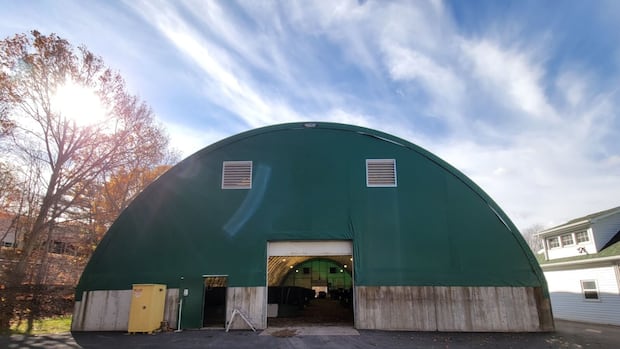
 The exterior of the biodiversity facility in Coldbrook, N.S. (Department of Fisheries and Oceans)
The Department of Fisheries and Oceans says the decision to close biodiversity facilities in Mactaquac, N.B., and Coldbrook, N.S., came down to a poor return on investment.
Inner Bay of Fundy Atlantic salmon is a population on the brink of extinction, with fewer than 110 wild salmon returning to rivers annually.
For 25 years, DFO has run live gene banks in the two facilities, conserving and tracking genetic diversity. It also operates a hatchery and releases fish into the water.
But it all ends this fall.
Kent Smedbol, a DFO manager who used to oversee the facilities, said the $2.3-million annual cost of the facilities had to be reconsidered because the fish return rate averages less than one in 300.
“There’s no evidence of recovery,” he said. “So, one might want to ask: is this then the best use of public resources?”
He said the latest federal budget introduced broader cuts to the whole government,
This story was brought to Nouzie by RSS. The original post can be found on https://www.cbc.ca/news/canada/nova-scotia/dfo-explains-closure-of-biodiversity-facilities-9.7184619?cmp=rss

