

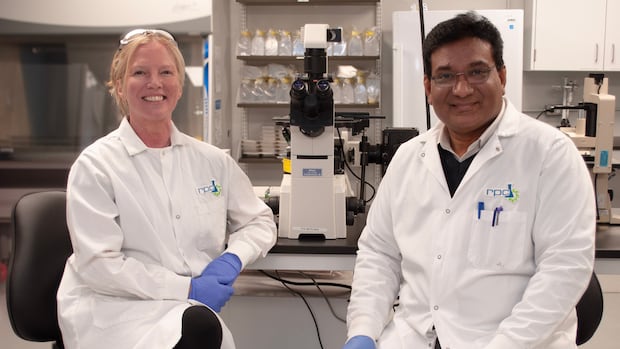
The Research and Productivity Council in Fredericton has mapped the DNA of MSX. It brings them closer to knowing how to fight the disease that’s threatening the Atlantic oyster industry.
Fredericton scientists discover how MSX disease is built, something no one else in the world has done

Katelin Belliveau · CBC News
· Posted: Mar 16, 2026 5:00 AM EDT | Last Updated: 2 hours ago

Listen to this article
Estimated 4 minutes
The audio version of this article is generated by AI-based technology. Mispronunciations can occur. We are working with our partners to continually review and improve the results.
 Attiq Rehman, director of bioscience at the Research and Productivity Council, and Rebecca Liston, supervisor of fish health sciences, spent months isolating an MSX cell. (Submitted by the Research and Productivity Council)
When scientists managed to isolated a single cell under a microscope months into their research on a deadly oyster disease, they knew they were onto something big.
“This is kind of a breakthrough,” said Attiq Rehman, director of bioscience at the Research and Productivity Council in Fredericton. “Nobody has ever done it.”
Rehman and colleague Rebecca Liston mapped a cell of MSX, a disease caused by a parasite that’s already contaminated oysters in the Northumberland Strait.
Not much was known about the parasite until this point.
This story was brought to Nouzie by RSS. The original post can be found on https://www.cbc.ca/news/canada/new-brunswick/oysters-msx-research-shellfish-fishery-new-brunswick-9.7123626?cmp=rss

