

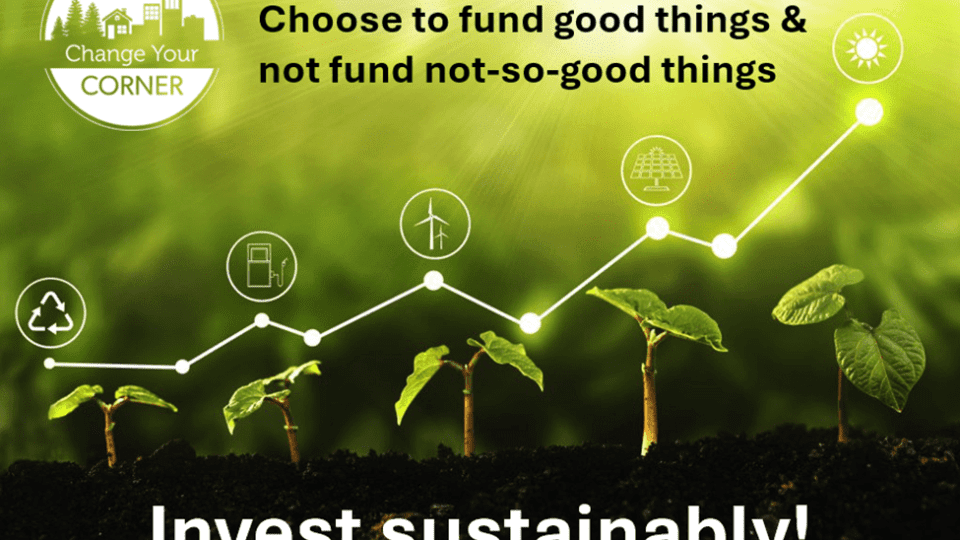
In our capitalist system, money makes things happen, and lack of money prevents things from happening. That can be a good thing or a bad thing, depending on how you look at it.
For example, money made the oilsands happen: it’s an engineering marvel; a financial jackpot and an ongoing ecological disaster. On the other hand, lack of money is preventing the widespread uptake of solar energy – free power from the sun in perpetuity once you install the equipment to harvest it.
While most of us probably don’t have extra cash hidden in our mattresses, most of us actually do have a stake in investments:
- Almost everyone is a member of the Canada Pension Plan (CPP), our federal government’s universal pension plan
- Many people have employer pension plans through their workplaces, such as the type civil servants or teachers would have
- Some people own Registered Retirement Savings Plans (RRSPs), Tax-Free Savings Accounts (TFSAs) or First Home Savings Accounts (FHSAs), funds which they personally own and direct
And it’s right to wonder: is our money invested strictly on the basis of maximum financial return (in which case the quote below should resonate)? Is it invested through the lens of sustainability with lesser emphasis on financial returns? Or does it put high importance on both priorities?
One would hope it’s the latter – but unfortunately that’s often not the case. According to the Canadian Pension Climate Report Card issued last week by Shift Action, a non-profit that tracks the sustainability of pension fund investments, the Canada Pension Plan scored a dismal D, second lowest of all pensions evaluated. In contrast, La Caisse, the Quebec equivalent of the CPP, scored an A-, the best score in the four-year history of the report card.
And when it comes to personal RRSPs, TFSAs or FHSAs, many of us rely on personal financial advisors who are generally market-focussed and sustainability-agnostic.
In both cases, the result is that often our pension money ends up funding unsustainable activities and not funding sustainable activities.
So what to do? Here are some actions, high level and personal:
- Make your voice heard by contacting the Canada Pension Plan to lobby for a more sustainable approach to investing, and for reinstatement of the climate commitments that were quietly abandoned in May 2025
- Show up at the annual meeting of your employer pension plan (many are held online) to advocate for more sustainable investing. If you can’t make it in person, send an email to the plan managers, who are more likely to act when they hear from enough people.
- Strive to make sustainable investing a priority in your personal investment portfolio by asking your financial advisor to shun fossil fuels and focus on solid, sustainability-focussed investments that offer the potential of good returns. It may take a little persistence, as MANY mutual funds have significant fossil fuel holdings – but the number of sustainable investment opportunities is growing steadily as more investors demand it. As an example, here’s Corporate Knights’ guide to the best green funds of 2025 (no endorsement intended).
Money is a pretty important thing, so always use good judgement – but know that sustainability and good returns are compatible. Personally, I divested of fossil fuels over a decade ago, and my retirement portfolio has done just fine without them.

February is RRSP month for many. Why not make sustainability a priority in your investments, to ensure your money is preventing bad things from happening, and helping make good things happen.
Quotable:
“Not everything that counts can be counted and not everything that can be counted counts.”
- William Bruce Cameron, “Informal Sociology: A Casual Introduction to Sociological Thinking”, 1963
This story was brought to Nouzie by RSS. The original post can be found on https://carlsgreenideas.wordpress.com/2026/02/04/this-rrsp-season-choose-sustainable-investments/

