

June 10, 2025
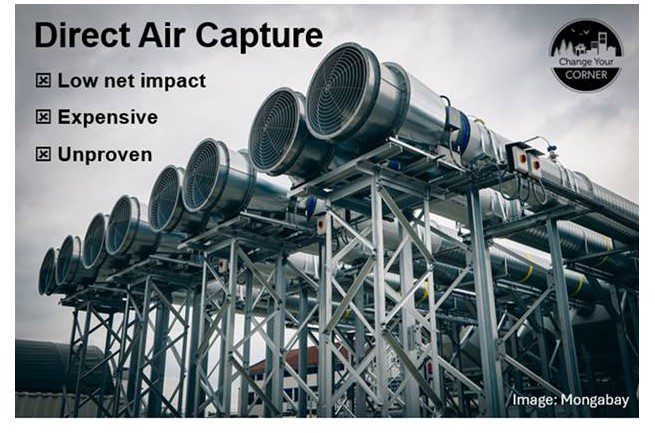
Truth about Direct Air Capture
Perhaps you’ve heard of direct air capture as a means of solving climate change: the use of large machines to filter carbon dioxide out of the air. The technology was launched a few years ago, and early projects in British Columbia and Iceland received a lot of media coverage.
But direct air capture has always had a few enormous technical issues:
- Capturing CO2 from the air is really hard. CO2 has a huge role in causing climate change, but in reality it is only .04% of the atmosphere. That means you need to filter a LOT of air to get a tonne of CO2. It’s not unlike gold mining, where the typical tonne of raw ore contains only a few ounces of gold. Except gold is worth over $3000/ounce; CO2 is not.
- The machines that do the filtering require a lot of energy. Where that energy comes from is a huge issue. Projects in Iceland are justified on the basis that they use that country’s clean, renewable electricity – but it could be argued that emissions would be reduced more if that electricity were instead used to electrify transportation and get gas vehicles off the road.
- Each machine captures only a small amount of CO2. One entire plant in Iceland captured just 105 tonnes of CO2 last year, equal to less than 1/10th of a second of global emissions. Yes, one-tenth of a second – which means we’d need over 30 million such plants to offset current annual global emissions.
- Once captured, CO2 must be stored permanently. That’s another technically challenging process. There’s a risk of it leaking back into the atmosphere, which would undo everything.
Here’s a recent analysis of direct air capture that nicely explains its weaknesses and limitations.
(Plus if you visit the website of the company that runs the Iceland direct air capture facilities, perhaps like me you’ll get the impression that it’s less about carbon removal and much more about carbon credits and money.)
Add up everything about direct air capture, it becomes fairly obvious:
- Solutions like efficiency and renewable energy are much cheaper and much easier to do at the scale needed to fight climate change; they give much more bang for the buck, so should be our top priorities.
- Fringe technologies with high costs and minimal impacts like direct air capture and its sibling carbon capture and storage belong at the very bottom of our list of climate solutions and priorities.

This story was brought to Nouzie by RSS. The original post can be found on https://carlsgreenideas.wordpress.com/2025/06/10/when-the-pin-touches-the-balloon-reality-is-showing-that-a-proposed-climate-solution-is-no-solution-at-all/

