


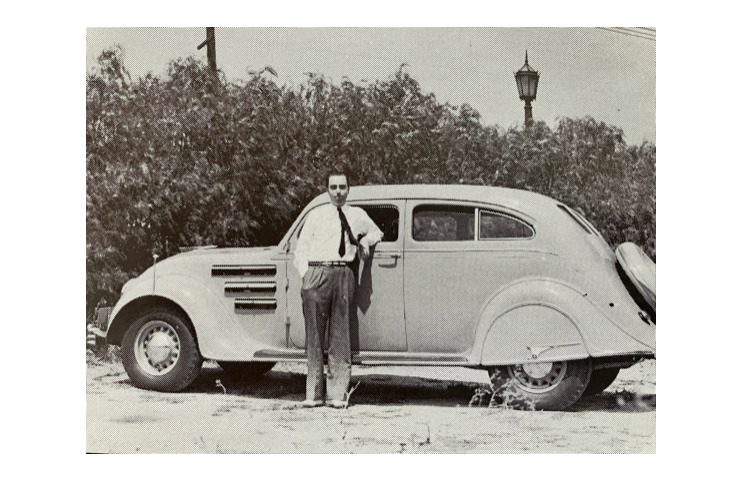
Della Glenn was shocked! All night she had worked hard in the kitchen, cooking for the big crowd at dinner, a bigger crowd than usual for a Saturday night at the Glenn Hotel in Chipman. And now, tired and with only a few hours to sleep before she got up and went at it all again, there was this.
Down the hall, she could hear the familiar giggling sound coming from behind her son Percy’s half-opened door. In the dim light, she could barely see him peeking around the corner at her.
That boy’s done it again, she thought as her eyes suspiciously traced the wire along the door casing down to the doorknob where, moments before, her tingling hand felt the small electrical shock. Accustomed to these surprises from her son, she smiled at the small, mischievous boy who would one day become a giant of Hollywood. Not as an actor but as a pioneer in sound-recording technology.
Glen Percy Raymond Glenn was born November 25, 1907, in a farmhouse outside Chipman. Sometime around 1925, the young electronics prodigy stood at the Chipman train station saying goodbye to his family. He was heading to New York City to study the new and exciting field of sound recording technology.
It had only been about 40 years since Edison invented the phonograph, and “radio schools” were a popular destination for young men looking for a challenging career. Radio school was Percy’s ‘ticket outta town,’ his escape from the drudgery of either working in the woods, the sawmills of Chipman or the coalmines in Minto.
Driving through Chipman recently, I thought about young Percy Glenn and what he must have been thinking on that long-ago day. Innocent and fresh-faced as a character in a Norman Rockwell painting, he had no idea of the remarkable adventure he was in for. A story someone in the Glenn family told me years ago — that for good luck, Della pinned a ten-dollar bill to her son’s long underwear before he got on the train — may or may not be true. If it isn’t, it should be.
After graduating from radio school in the late 1920s, Glen moved to Los Angeles to do sound recordings for the studios. Silent movies were on the way out, and “the talkies” were on the way in. Well-liked and well-respected, he rapidly gained a reputation as a dynamic and innovative sound engineer as he developed contacts around Hollywood.
In 1951, Lucille Ball and Desi Arnaz, with whom Glen had become friends, asked him if he would do the sound work at a reduced rate for their new studio’s first television program, I Love Lucy. Glen agreed, stipulating that he wanted Glen Glenn Sound to do all the sound work if the show and Desilu Productions were successful.
With the success of I Love Lucy, the future of Glen Glenn Sound was assured. The company provided services for over 20,000 movies and TV shows, including Bonanza, Mission Impossible, The Dick Van Dyke Show, Get Smart, Star Trek, and The Andy Griffith Show.
Glen’s success allowed him, his wife Mary Helen, and their four children to spend summers in New Brunswick. During their summer visit in 1960, Glen got a call requesting his return to Los Angeles to deal with labour problems at Glen Glenn Sound.
On Saturday, August 20, 1960, the night before they were to catch their flight from Fredericton, friends and family held a going away party for Glen and Mary Helen at Glen’s brother’s cottage on Grand Lake. As they said their goodbyes at the end of the evening, the couple regretted having to cut their visit short. Waving goodbye through the screen door, Earl Glenn watched as the taillights of his brother’s rented Ford slowly disappeared into the darkness.
Silence forever.
At seven o’clock the next morning, on his way home from work, coal miner Arnold Boone saw the roof of a half submerged car sticking out of Newcastle Creek. A short time later, Dr. Gardiner, who had shared their company at the party just a few hours before, signed Glen and Mary Helen’s death certificates.
On August 25, 1960, Glen and Mary Helen were laid to rest together in unmarked graves overlooking the ocean at Green Hills Memorial Park, Rancho Palos Verdes, California.


Great story as always, and one I knew absolutely nothing about. Thanks once again Lane.