


Find glyphosate spraying near your community using our up-to-date map of herbicide hotspots, then use our letter-writing tool to tell your MLA you want this unnecessary and old-fashioned practice to stop
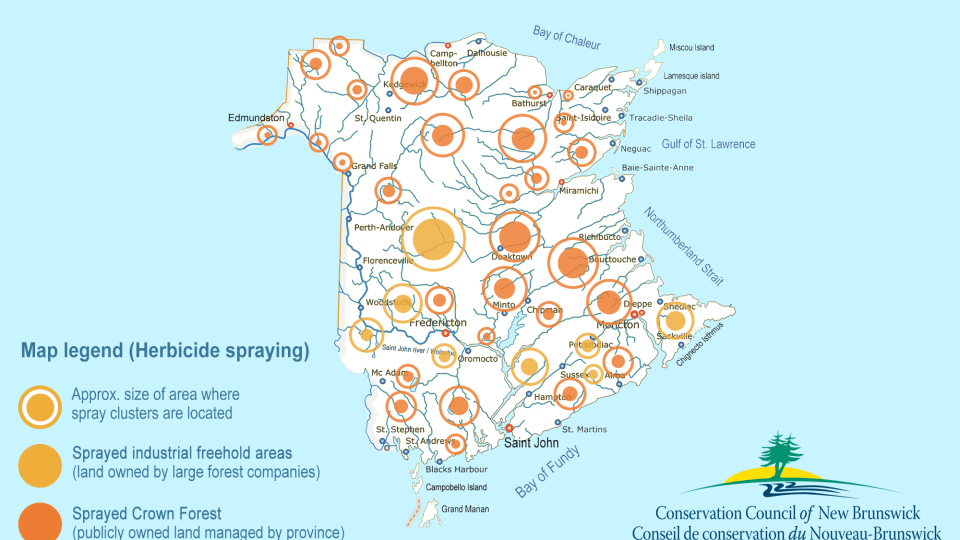
The map showing where New Brunswick forests will be sprayed with herbicides during summer 2023 is now available.
Our team is poring over the map to help New Brunswickers identify the major spraying hotspots this summer. Stay tuned to this page for more maps showing spraying hotspots across the province and within our watersheds.
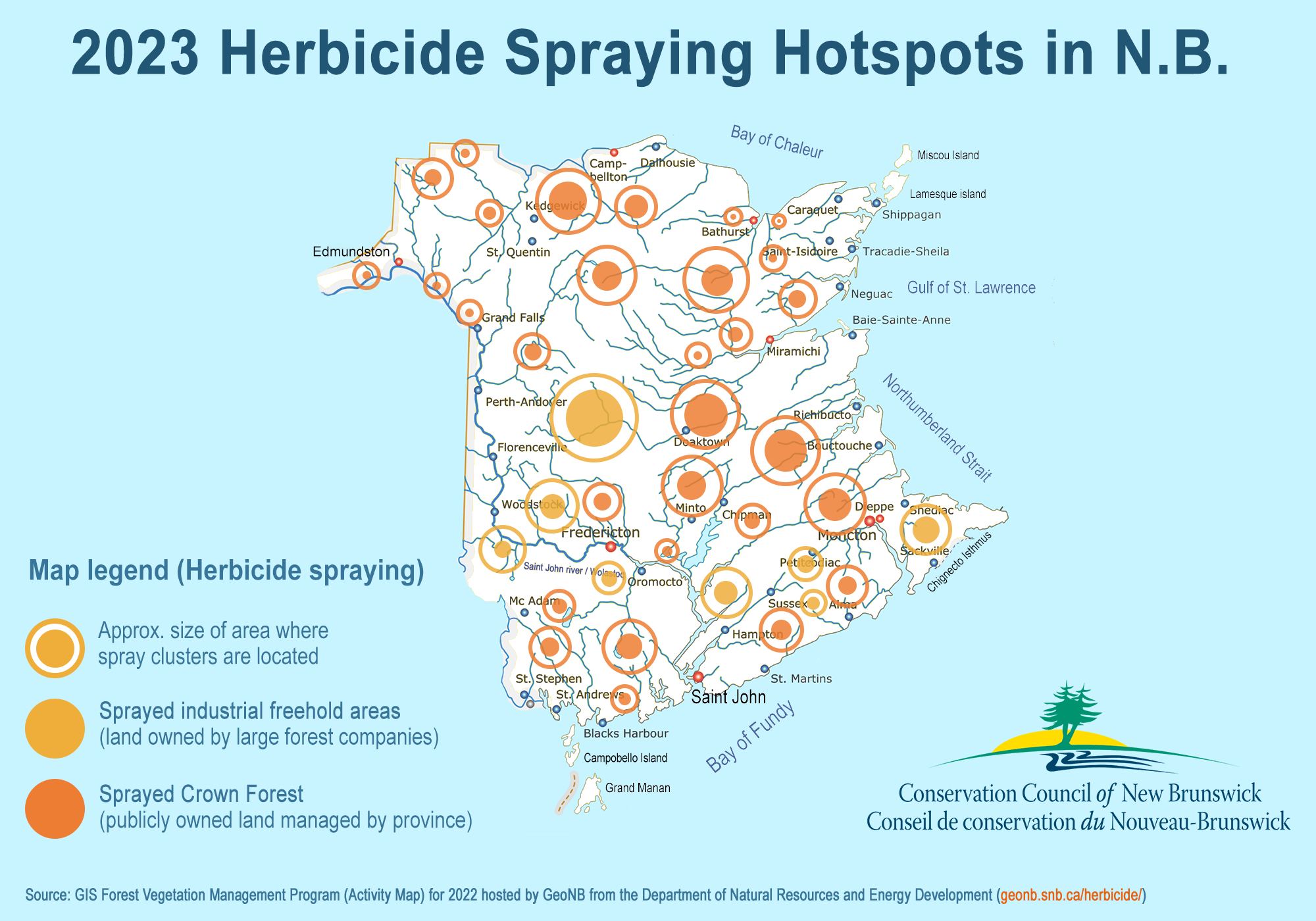
(Click on the map to zoom in)
Navigation menu
2023 Update: Herbicide Spraying in New Brunswick
Every year starting in August and continuing through September, companies spray large swaths of clear cuts with products containing glyphosate. These herbicides being sprayed in New Brunswick’s Crown forest are a symptom of a larger problem—an old-fashioned management regime that sees corporate profits and timber supply trump everything.
Although Health Canada announced in 2019 that “No Pesticide regulatory authority in the world currently considers glyphosate to be a Cancer Risk at the levels humans are currently exposed,” these claims are based on outdated evidence from 2017.
These claims also fail to address the fact that New Brunwick has the highest rates of Glyphosate use in forestry based on land mass and that glyphosate use on crown land continues to increase.
Despite being required to conduct a rigorous scientific assessment of glyphosate in February of 2022 and being given strongly-worded direction on how to conduct a proper review, Canada renewed its registration for the herbicide for a further five-year period.
Glyphosate remains under high scrutiny in Canada as environmental and food groups took Health Canada to court over glyphosate renewal in January of 2023. Toronto Lawyer Laura Bowman who is representing Eco justice in this lawsuit, claims it may take Canada 20-30 years to update the threats on each pesticide, and Glyphosate may not be investigated again until 2030.
New potential risks associated with glyphosate continue to emerge. Not to mention possible health concerns that New Brunswickers continue to have. Glyphosate is is known to affect beneficial insects, bird populations and Freshwater ecosystems that then indirectly effects other wildlife dependant on these food and shelter sources. Over 35,0000 New Brunswickers want Glyphosate out of their food, water, and first and foremost their Forests.
Year after year communities rally demanding change in how New Brunswick Manages its forests. Yet the Government continues to claim that Glyphosate is the only option. We need to have legislators standing up with citizens and scientists.
“You’re going to hear from industry, ‘We can’t do things differently’— I don’t buy it. There are a lot of smart foresters in this province, there is a lot of talent within the industry. If they put their mind to it, they can do it. But if we don’t have legislators standing up with citizens and scientists saying we have to do this, industry will not change.”,” Corbett told the Standing Committee on Climate Change and Environmental Stewardship during the 2021 glyphosate hearings in New Brunswick.
“We have the climate change crisis. We have a crisis in nature. We have First Nations and private woodlot owners demanding fairness, and we have overwhelming public support for change. This is not the time for small goals. It’s time to do what the forests and wildlife need, what our citizens want, and what New Brunswickers deserve.”
Send your #StopSpraying letter today!
Take action now! Your letter will be sent to:
- Blaine Higgs, Premier of New Brunswick
- Gary Crossman, N.B. Minister of Environment and Climate Change
- Mike Holland, N.B. Minister of Natural Resources and Energy Development
- New Brunswick party leaders: David Coon (GP), Susan Holt (L), Blaine Higgs (PC), Alex White (NDP)
- Your MLA (based on your postal code)
The 2021 Glyphosate Hearings in New Brunswick
In June and September 2021, the Standing Committee on Climate Change and Environmental Stewardship held hearings on glyphosate use in New Brunswick.
Our previous Executive Director, Lois Corbett, was among the experts, conservation groups, scientists, and citizens groups who spoke out against spraying during the hearing and called for a better approach to forest management in New Brunswick based around ecological forestry.
“You’re going to hear from industry, ‘We can’t do things differently,’” Corbett told committee members last summer. “I don’t buy it. There are a lot of smart foresters in this province, there is a lot of talent within the industry. If they put their mind to it, they can do it. But if we don’t have legislators standing up with citizens and scientists saying we have to do this, industry will not change.”
“Like a crutch when you have a broken leg, herbicides are a symptom of a broader problem: large-scale clearcutting and an out-dated forest management strategy,” Corbett added as she called for an update to the 30-year-old Crown Lands and Forests Act.
“We have the climate change crisis. We have a crisis in nature. We have First Nations and private woodlot owners demanding fairness, and we have overwhelming public support for change. This is not the time for small goals. It’s time to do what the forests and wildlife needs, what our citizens want, and what New Brunswickers’ deserve.”
What’s the problem with spraying herbicides containing glyphosate?
Forestry companies spray clearcut areas with herbicides to kill hardwoods and vegetation that compete with the spruce, fir and pine they grow in plantations. The Conservation Council has long advocated that the province stop the old-fashioned, citizen-funded practice of spraying the forest. Quebec banned the spraying of its public forest more than two decades ago.
In 2016, New Brunswick’s Chief Medical Officer of Health’s Action Plan on Glyphosate found that New Brunswick uses more glyphosate per hectare of harvested forest than any province in Canada.
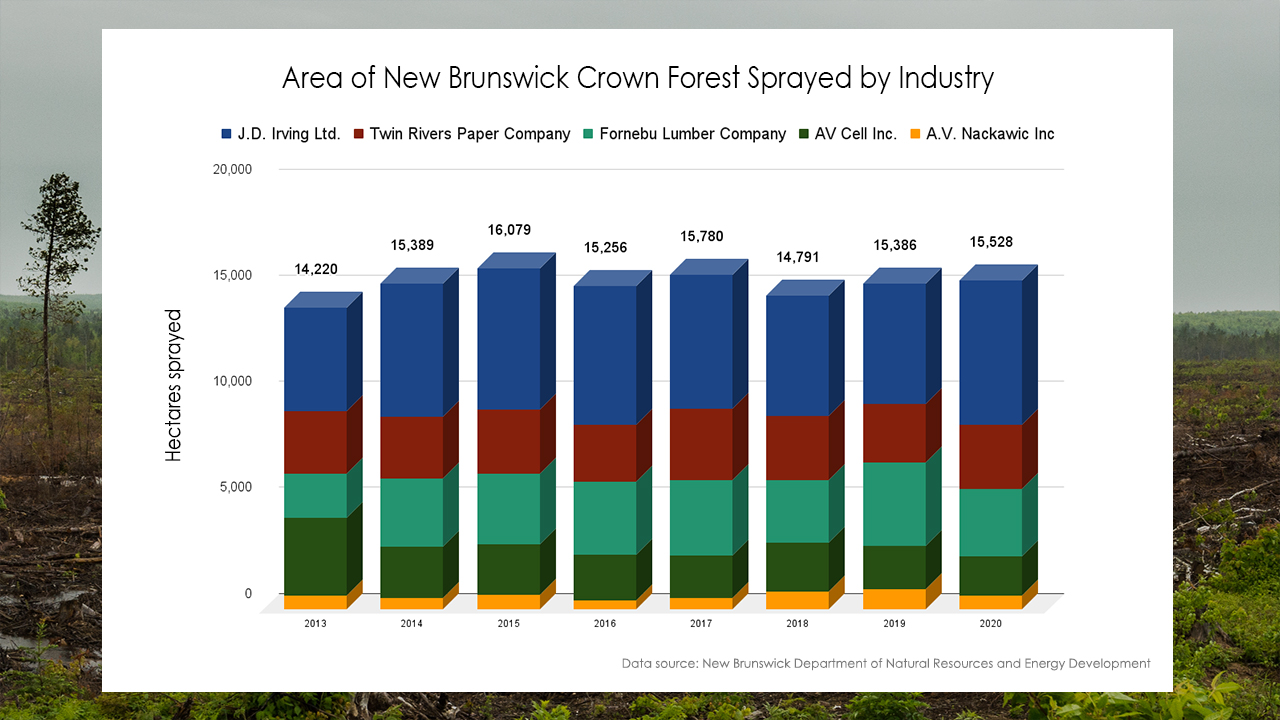
More Stories: Glyphosate Spraying
Help us continue our work for ecological forestry in New Brunswick
Share this article with your friends and family and invite them to join you in calling for an end to spraying in N.B.!
This story was brought to Nouzie by RSS. The original post can be found on https://www.conservationcouncil.ca/2023-hotspots-for-herbicide-spraying-in-n-b/?utm_source=rss&utm_medium=rss&utm_campaign=2023-hotspots-for-herbicide-spraying-in-n-b

